"It's easy to view a layoff as an end-of-the-world situation, especially when the economy is bad. But a negative attitude will only hurt your chances of finding a new job. To help you mentally and emotionally, a career coach offers his seven tips for surviving a layoff and finding a new job.
It's easy to view a layoff as an end-of-the-world situation. Few experiences are scarier than losing your job and the financial security it brings.
The fear and desperation that grip you after you've been laid off are destructive emotions. They distract you from doing the work you need to do to find a new job. That's why you can't let those emotions consume you, says Dr. Richard Bayer, a former professor of economics and ethics who currently serves as COO of The Five O'Clock Club, a career coaching and outplacement network.
"Resist the urge to think of unemployment as the end of the world, no matter how upsetting it may be," he says. "Think of it instead as an opportunity to improve yourself and to make a fresh start. Maybe you're going to find out that what you enjoy doing and do well is different from what you were doing. You can end up better off than you were before."
The key, says Bayer, is maintaining a positive attitude because potential employers can detect a candidate's desperation as easily as a shark can smell blood, and they don't like it. To keep a stiff upper lip, Bayer offers the following seven tips for thriving after a layoff, even in a bad economy.
1. Negotiate for the best possible severance package
Don't think that you have to accept whatever severance package your manager or HR puts in front of you as is, says Bayer. Your severance package is negotiable, he says, so don't feel pressured to immediately sign on the dotted line. Take the time to read the severance package, even if it's 20 pages long.
If your employer gives you a hard time, Bayer says to hold your ground and tell the manager that it's not reasonable for the employer to ask you to sign something without first reading it.
"Sometimes employers will say, 'If you sign this right now, you'll get your best deal. If you don't sign it, you'll get a worse deal'," says Bayer. "I wouldn't buy into that. Tell them you have to sleep on it. There's nothing that should surprise them about you wanting to sleep on it."
To help you prepare for severance negotiations, Bayer recommends consulting your HR manual for information about what kind of severance package you should expect from your employer. That way, you can plan ahead of time what other elements of a severance package (e.g., career counseling, health insurance) you might need.
If you require more information than what's included in the HR manual, Bayer suggests politely asking other employees who've been let go what they received for severance.
When it comes to actual negotiations, Bayer advises negotiating one perk at a time, whether it be the money, healthcare or career coaching, rather than going after the whole package. "You always get more if you look at one thing at a time," he says. "Your mantra should be, 'I just want to be treated fairly.' "
Finally, Bayer recommends conducting negotiations on your own, without a lawyer, not just because of the expense. "Once you get lawyers involved, it's lawyers talking to lawyers. You lose a certain amount of control," he says. "Try to work it out with the firm in a congenial way."
2. Don't second-guess yourself
After you've been laid off, you feel vulnerable. When you feel vulnerable, it's easy to second-guess yourself and to sink into depression. What's difficult is resisting those negative thoughts. But for your own well-being and the success of your job search, you have to, says Bayer.
Instead of dwelling on all the reasons why your employer might have selected you for a pink slip, Bayer says to remember that the fundamental reason you lost your job was because your employer was having trouble competing during this economic downturn, not because you're a bad worker. Bayer says to keep in mind that lots of other talented, hard-working professionals are getting laid off and that you can still be a valuable employee at another company.
"There are still plenty of companies that are in desperate need of quality employees," he says. "There is something else out there for you, and chances are, it's a great opportunity that will improve your future."
3. Examine your finances
Take a close look at your expenses and your savings to determine how much money you'll need to cover your expenses during the time you're unemployed, says Bayer. He recommends planning for an extended period of time-e.g., more than three months.
Knowing how much money you have on hand could put some of your anxiety about having lost your job to rest. If instead the exercise of managing your money sends your blood pressure through the roof, you've got new motivation to find a new job.
4. Make job-hunting your new job
Another way to prevent getting depressed about your circumstances is to stay active, says Bayer. That's why it's so important to devote the time you previously spent at your old job to looking for a new job.
"Your new job is 40 hours a week looking for employment," says Bayer. "Keep busy at it and don't let yourself get down. Try to keep a routine."
By working toward getting a new job, you bring structure and discipline to your life and you'll feel better about yourself because you're taking control of your situation.
"If you do this, you'll find that you have less time to lament your recent layoff and less time to sink into the negative thought patterns that are associated with it," he says.
5. Expand your search
Bayer recommends making a long list of industries and organizations in those industries where you could put your skills and experience to use. "Don't worry too much about who might be hiring," he says. "Just develop a long list even containing companies you don't want to work for."
The reason to include less desirable companies in your search is to put yourself in a stronger negotiating position in the event one of those firms suddenly wants you.
6. Approach online applications with caution
Though the Web is an invaluable resource for researching companies, it's not the best medium for submitting job applications and résumés, says Bayer. "If you can do it, about a million other people can do it, too," he says. "I've talked to companies who get hundreds, even thousands, of résumés for one posting. That is not the way to get a job."
Instead, he recommends using your network to make contact with hiring managers inside the companies where you're interested in working.
Instead of spending a day at search firms, attend a conference or networking event, says Bayer, where you have the opportunity to make personal connections.
7. Stop reading about the economy
Bayer cautions job seekers against paying too much attention to news about the economy because the news is so bad. "It makes people discouraged when they need to stay optimistic," he says. "Discouragement is the biggest obstacle to finding a new job."
What's more, prospective employers can sense discouragement and negativity in candidates, he says, and it turns them off.
"If they sense that you're negative or in a panic, they're much less likely to think that you're a good candidate," says Bayer. "They want someone who's resilient. They don't want an employee who's discouraged and negative and who will hurt morale." - Meridith Levinson


Tuesday
Free Job Hunting Webinar
WEBINAR-
EVENT: “Confessions of a Job Search Strategist”
DATE: November 1, 2008
TIME: 11:00am EST (1-hour)
PLACE: Virtual
COST: $0.00
PURPOSE: “Confessions of a Job Search Strategist” is a free job hunting webinar to assist the general public with cutting-edge job hunting strategies. It is being presented by Jim Stroud...
.THIS IS AN ONLINE EVENT! - Sign up now! Go to:
www.HowToFindaJobOnTheInternet.com
Want more details? Read on…
Eventhough times are tough, its not impossible to find work to support yourself and your family. I remember the last recession of 2002 when I had bills to pay, mouths to feed and no interviews pending. How is that for irony - a Recruiter looking for work?
Like every other job seeker, I placed my resume on Monster, scanned the newspaper and asked people if they knew of any openings. In other words, I was doing what everyone else was doing, at the same time, but for some reason I was expecting different results. Two weeks into my job search I decided to do something different and today I am still reaping the rewards from my efforts back in 2002.
In my free webinar, “Confessions of a Job Search Strategist” you will learn the following:
Where does your resume really go? (The Blackhole Explained)
Why Job Boards don’t matter (and why they do)
How to use Google to discover jobs that most people will never see
How to get Recruiters to chase after you
The class is 1-hour to include a Question and Answer session.
Notes will be made available for downloading after the session.
Plus, a unique money-making opportunity will be presented at the conclusion of the class.
.THIS IS AN ONLINE EVENT! - Sign up now! Go to:
www.HowToFindaJobOnTheInternet.com
AFTER YOU REGISTER FOR THIS EVENT:
A follow-up email will be sent to you with instructions on how to participate in the webinar. This email will be sent a few days prior to the event and then a second time, one day before the event.
All you need is the ability to surf the internet and talk on the phone at the same time.
.THIS IS AN ONLINE EVENT! - Sign up now! Go to:
www.HowToFindaJobOnTheInternet.com
ABOUT THE PRESENTER:
Jim Stroud is a Social Media Development Manager for EnglishCafe, the premier English learning community for global professionals. Its parent company - GlobalEnglish Corporation, is the leading provider of on-demand business English communication learning and support for the world’s top companies.
Prior to EnglishCafe, Jim Stroud amassed a decade of experience in the Recruiting field. As a self-described “Searchologist,” Jim has consulted for such companies as Microsoft, Google, MCI, Siemens and a host of startup companies.
When not engaged in Recruitment Research, Competitive Intelligence and Training projects for the aforementioned organizations, Jim created and sold two online properties while managing an award-winning blog – The Recruiters Lounge. He is also the co-host of the video series - I Live Online.
When he is not online, Jim suffers severe withdrawal pains that can only be soothed by chocolate chip cookies and family time.
EVENT: “Confessions of a Job Search Strategist”
DATE: November 1, 2008
TIME: 11:00am EST (1-hour)
PLACE: Virtual
COST: $0.00
PURPOSE: “Confessions of a Job Search Strategist” is a free job hunting webinar to assist the general public with cutting-edge job hunting strategies. It is being presented by Jim Stroud...
.THIS IS AN ONLINE EVENT! - Sign up now! Go to:
www.HowToFindaJobOnTheInternet.com
Want more details? Read on…
Eventhough times are tough, its not impossible to find work to support yourself and your family. I remember the last recession of 2002 when I had bills to pay, mouths to feed and no interviews pending. How is that for irony - a Recruiter looking for work?
Like every other job seeker, I placed my resume on Monster, scanned the newspaper and asked people if they knew of any openings. In other words, I was doing what everyone else was doing, at the same time, but for some reason I was expecting different results. Two weeks into my job search I decided to do something different and today I am still reaping the rewards from my efforts back in 2002.
In my free webinar, “Confessions of a Job Search Strategist” you will learn the following:
Where does your resume really go? (The Blackhole Explained)
Why Job Boards don’t matter (and why they do)
How to use Google to discover jobs that most people will never see
How to get Recruiters to chase after you
The class is 1-hour to include a Question and Answer session.
Notes will be made available for downloading after the session.
Plus, a unique money-making opportunity will be presented at the conclusion of the class.
.THIS IS AN ONLINE EVENT! - Sign up now! Go to:
www.HowToFindaJobOnTheInternet.com
AFTER YOU REGISTER FOR THIS EVENT:
A follow-up email will be sent to you with instructions on how to participate in the webinar. This email will be sent a few days prior to the event and then a second time, one day before the event.
All you need is the ability to surf the internet and talk on the phone at the same time.
.THIS IS AN ONLINE EVENT! - Sign up now! Go to:
www.HowToFindaJobOnTheInternet.com
ABOUT THE PRESENTER:
Jim Stroud is a Social Media Development Manager for EnglishCafe, the premier English learning community for global professionals. Its parent company - GlobalEnglish Corporation, is the leading provider of on-demand business English communication learning and support for the world’s top companies.
Prior to EnglishCafe, Jim Stroud amassed a decade of experience in the Recruiting field. As a self-described “Searchologist,” Jim has consulted for such companies as Microsoft, Google, MCI, Siemens and a host of startup companies.
When not engaged in Recruitment Research, Competitive Intelligence and Training projects for the aforementioned organizations, Jim created and sold two online properties while managing an award-winning blog – The Recruiters Lounge. He is also the co-host of the video series - I Live Online.
When he is not online, Jim suffers severe withdrawal pains that can only be soothed by chocolate chip cookies and family time.
What is the cause of the banking crisis?
What You Should Know If Your Bank is in Trouble
By Edmond P. Freiermuth
The recent FDIC takeover of IndyMac Bank, seizure and sale of Washington Mutual and forced sale of Wachovia, indicates that the seize-up in credit markets has spread from global and investment banks to regional and community banks. While the vast majority of the banks in the United States are in sound condition, there may be more failures to come. Business owners should know the facts about being a depositor or a borrower in a FDIC-insured bank. Here are some frequently asked questions.
What is the cause of the banking crisis?
During the past decade, two key financing flaws occurred. First, the mega-banks began to package and sell the loans they made. This process, called asset “securitization,” allowed for the origination of loans at an unprecedented scale. The banks that originated the loans kept little of the debt on their books. Second, the underwriting standards for giving loans were “liberalized” to such an extent that millions of traditionally unqualified borrowers were granted loans they could not repay. This created trillions of dollars of high-risk securitized debt.
As home foreclosures rose, the entire asset class of securitized debt became suspect and investors no longer wanted to own securitized debt, also known as “paper.” This led to a chain reaction: Banks could no longer sell off loans and were forced to look for other sources of money to lend and those sources quickly tightened up. Now banks are in a position where they can’t make many loans because they themselves can’t borrow the money to make loans. Banks need to make loans to make money.
While big banks and investment banks made substantial disclosures (acknowledged losses of $400 billion so far) and received cash injections earlier in the year, regional and community banks are now going through the same process. This is especially true in U.S. regions that experienced the greatest benefits of hyper-growth in real estate-related industries. California and Florida are the two biggest states impacted by what could reasonably be called a real estate depression.
Additional worries are coming from the fact that Freddie Mac and Fannie Mae (holders of about half of all U.S. mortgage debt) may not have enough cash or credit to continue buying mortgages. Without a bailout from the U.S. government, the housing market could effectively shut down. The U.S. economy is resilient and will get through this test. But the banking industry losses will be severe--perhaps exceeding $1 trillion over the next two years.
Liberal lending in all of the arcane new forms created by the world’s investment banks and commercial banks drove the global economy for the past 10 years. The mutual funds, banks, money markets and individuals who invested in “paper” will bear the losses and are likely to be extremely wary in the future (at least for a while). So, banks will be required to hold more of the loans they create. Although The Federal Reserve and other central bankers will provide liquidity to the banking system, chastened lenders are unlikely to be quite so cavalier in extending credit to borrowers without demonstrable means of repayment. In addition, regulatory oversight will be increased.
How should businesses with more than $100,000 in FDIC-insured deposits in a single bank protect their assets?
The FDIC insures business deposits on a per-taxpayer-ID basis up to $100,000. To fully protect bank deposits over $100,000 you can take one of two actions.
• If you are borrowing money from the bank, pay down the amount of the loan outstanding such that your depository account balance does not exceed $100,000.
• You can transfer funds in excess of $100,000 to other banks.
How can individuals protect more than $100,000 in an FDIC-insured bank?
Individuals can get more coverage by designating different ownership categories to their accounts at the same bank. For example, a husband and wife can qualify for $600,000 in total FDIC coverage at one bank by opening the following five account types.
What does it mean if a bank is on the FDIC’s watch list?
It was recently reported that 90 banks are currently on the banking regulators’ “watch list.” Being on the list does not necessarily mean that failure will occur. It does mean that the banks’ ability to grow, without significant injections of additional capital, will be curtailed. The banks on the list may be required to shrink their outstanding credit.
If you bank with a bank on the watch list, the bank might reduce your revolving credit line, decline to make you a term loan, or increase your interest rate.
How can business owners perform due diligence on a bank?
The common stock of most banks is publicly traded. As such, they are required to file periodic financial reports with the U.S. Securities and Exchange Commission. Additionally, all banks must also file periodic Call Reports with bank regulators. Banks also publish financial statements that are available just by asking your relationship manager/loan officer. These documents contain a wealth of information about banks.
Are there any signs that a bank might be in trouble?
The single greatest warning sign that indicates that bank is in financial trouble is when regulators issue a “cease and desist order” to the bank. Other signs a bank is in trouble include:
• Seriously declining stock value
• High executive turnover
• Recent changes in the management of your account
• No longer ranked as “well capitalized” by regulators.
Additionally, if bankers seeking your business should suddenly inundate you with offers, it may be that they know something about your bank that you don’t.
What happens if your business has a loan from a bank that gets taken over by the FDIC?
If the FDIC takes over a bank, it attempts to find a buyer for the bank for the full value of all assets. If the FDIC cannot find a buyer, it will sell liquid assets such as government securities and then try to sell loans, in bulk, to another lender, or lenders. In either case, if you have a loan with a bank that has been taken over, you may see changes in the payment method or terms of the loan. In the worst case scenario your loan may be called, forcing you to find a new lender. If your business is not performing well and/or is leveraged more than 3:1, it may be difficult to find a new lender. It’s good planning to have a back-up line of credit.
If your business has a loan from a bank that is taken over by the FDIC, you should immediately begin searching for a banking relationship with a new lender.
When the FDIC takes over a bank, how long do businesses have to wait before they can access their money?
If your total depository accounts are within the FDIC insurance limit of $100,000, you should be able to gain full access to funds within a few days. If your accounts are above the limit, it could take much longer and the exposure to loss could be significant for the excess amount. It all depends upon how bad the condition of the bank is, and when and how much the FDIC believes will ultimately be received from the sale or liquidation of the assets. Typically, the FDIC makes a preliminary estimate of the expected loss and then allows access to a certain percent of the uninsured funds on deposit in a few days.
How long will the turmoil in the credit and equity markets last?
Expunging the excesses caused by irresponsible lending and borrowing will take another 18-24 months to correct. There will, regrettably, be more bank failures.
Vistage Speaker Ed Freiermuth has more than 30 years' experience in financing and advising businesses of all sizes. He has worked directly with the CEOs and senior managers of more than 250 companies. As an independent business consultant, he works closely with lending officers, attorneys, accountants, venture capitalists, investment bankers and others seeking to resolve complex financial, marketing and operational challenges.
Keeping Your Cash Safe: How to Insure up to $50 million in Bank Deposits
By Paul Diamond
As confidence erodes in the U.S. financial system and the government scrambles to create a plan to restore that confidence, many business owners are wondering about the safety of their cash. While treasury bills, notes and bonds are typically viewed as the safest place for cash, there are new insured and convenient bank options.
Currently, the Federal Deposit Insurance Corp. (FDIC) insures up to $100,000 of a personal bank account and the same amount for a business bank account. If your bank were to fail, the FDIC guarantees that you will get up to $100,000 of your money back. Beyond that, historical averages show that claimants typically get back about 73 cents on the dollar. What’s the solution to insuring 100 percent of your business or personal cash that exceeds $100,000?
Enter CDARS (pronounced "cedars"). The Certificate of Deposit Registry Service allows people and businesses to work with one bank—their own bank—and get FDIC insurance on all of their cash, up to $50 million placed in Certificate of Deposits. CDARS is owned by Promontory Interfinancial Network, which has brought together some 2,500 financial institutions in the U.S.
Here’s how it works
If your bank is a member of the CDARS network, it can place your money in CDs at other banks that are members, thus spreading your money across multiple banks to take advantage of the FDIC insurance of $100,000 at each bank. If your bank is not a member, you can most likely find a member in your region.
You earn one interest rate on all the CD investments placed through CDARS. There’s no need to tally disbursements for each CD. You receive one statement that details all of your CD investments. There are no annual fees, subscription fees or transaction fees. You get all of the interest from the CD product that you choose. You can also select from maturity dates ranging from four weeks to five years and choose the terms that best suit your investment needs.
For many businesses, CDARS can be a valuable cash management or long-term investment tool. By providing access to up to $50 million in FDIC insurance through a single bank, CDARS can help simplify your job and improve your business' financial performance.
What’s the downside of CDARS?
The downside is that mostly smaller banks participate in its network. Typically, large national banks like Washington Mutual and Bank of America are not members. Additionally, CDARS makes its money by charging participating banks a transaction fee, so the CD rates you get through CDARS may be lower average CD accounts.
Insured money-market funds
On September 19th, the Treasury said that it will offer insurance coverage to money-market shareholders. It then clarified the announcement on September 21st, saying the insurance was “for amounts held by [money-market investors] as of the close of business on Sept. 19, 2008.” This means that any money investors had in a money-market fund as of the close of business on Sept. 19th, 2008 may be insured, if the money-market fund elects to pay the premiums for the new insurance. This insurance is slated to last for one year.
Money-market deposits made after September 19th are not eligible for coverage. Additionally, investors who lost money in money-market accounts prior to September 19th are not covered by this new insurance. Investors in the Reserve Primary Fund, which saw a 3 percent decline in value on Sept 16th and 17th, will not be covered for those losses by the new Treasury program. Call your money-market account to find out if your funds are covered.
Getting more FDIC coverage without using CDARS
Individuals can get more coverage by designating different ownership categories to their accounts at the same bank. For example, a husband and wife can qualify for $600,000 in total FDIC coverage at one bank by opening the following five account types.
What is the cause of the banking crisis?
During the past decade, two key financing flaws occurred. First, the mega-banks began to package and sell the loans they made. This process, called asset “securitization,” allowed for the origination of loans at an unprecedented scale. The banks that originated the loans kept little of the debt on their books. Second, the underwriting standards for giving loans were “liberalized” to such an extent that millions of traditionally unqualified borrowers were granted loans they could not repay. This created trillions of dollars of high-risk securitized debt.
As home foreclosures rose, the entire asset class of securitized debt became suspect and investors no longer wanted to own securitized debt, also known as “paper.” This led to a chain reaction: Banks could no longer sell off loans and were forced to look for other sources of money to lend and those sources quickly tightened up. Now banks are in a position where they can’t make many loans because they themselves can’t borrow the money to make loans. Banks need to make loans to make money.
While big banks and investment banks made substantial disclosures (acknowledged losses of $400 billion so far) and received cash injections earlier in the year, regional and community banks are now going through the same process. This is especially true in U.S. regions that experienced the greatest benefits of hyper-growth in real estate-related industries. California and Florida are the two biggest states impacted by what could reasonably be called a real estate depression.
Additional worries are coming from the fact that Freddie Mac and Fannie Mae (holders of about half of all U.S. mortgage debt) may not have enough cash or credit to continue buying mortgages. Without a bailout from the U.S. government, the housing market could effectively shut down. The U.S. economy is resilient and will get through this test. But the banking industry losses will be severe--perhaps exceeding $1 trillion over the next two years.
Liberal lending in all of the arcane new forms created by the world’s investment banks and commercial banks drove the global economy for the past 10 years. The mutual funds, banks, money markets and individuals who invested in “paper” will bear the losses and are likely to be extremely wary in the future (at least for a while). So, banks will be required to hold more of the loans they create. Although The Federal Reserve and other central bankers will provide liquidity to the banking system, chastened lenders are unlikely to be quite so cavalier in extending credit to borrowers without demonstrable means of repayment. In addition, regulatory oversight will be increased.
By Edmond P. Freiermuth
The recent FDIC takeover of IndyMac Bank, seizure and sale of Washington Mutual and forced sale of Wachovia, indicates that the seize-up in credit markets has spread from global and investment banks to regional and community banks. While the vast majority of the banks in the United States are in sound condition, there may be more failures to come. Business owners should know the facts about being a depositor or a borrower in a FDIC-insured bank. Here are some frequently asked questions.
What is the cause of the banking crisis?
During the past decade, two key financing flaws occurred. First, the mega-banks began to package and sell the loans they made. This process, called asset “securitization,” allowed for the origination of loans at an unprecedented scale. The banks that originated the loans kept little of the debt on their books. Second, the underwriting standards for giving loans were “liberalized” to such an extent that millions of traditionally unqualified borrowers were granted loans they could not repay. This created trillions of dollars of high-risk securitized debt.
As home foreclosures rose, the entire asset class of securitized debt became suspect and investors no longer wanted to own securitized debt, also known as “paper.” This led to a chain reaction: Banks could no longer sell off loans and were forced to look for other sources of money to lend and those sources quickly tightened up. Now banks are in a position where they can’t make many loans because they themselves can’t borrow the money to make loans. Banks need to make loans to make money.
While big banks and investment banks made substantial disclosures (acknowledged losses of $400 billion so far) and received cash injections earlier in the year, regional and community banks are now going through the same process. This is especially true in U.S. regions that experienced the greatest benefits of hyper-growth in real estate-related industries. California and Florida are the two biggest states impacted by what could reasonably be called a real estate depression.
Additional worries are coming from the fact that Freddie Mac and Fannie Mae (holders of about half of all U.S. mortgage debt) may not have enough cash or credit to continue buying mortgages. Without a bailout from the U.S. government, the housing market could effectively shut down. The U.S. economy is resilient and will get through this test. But the banking industry losses will be severe--perhaps exceeding $1 trillion over the next two years.
Liberal lending in all of the arcane new forms created by the world’s investment banks and commercial banks drove the global economy for the past 10 years. The mutual funds, banks, money markets and individuals who invested in “paper” will bear the losses and are likely to be extremely wary in the future (at least for a while). So, banks will be required to hold more of the loans they create. Although The Federal Reserve and other central bankers will provide liquidity to the banking system, chastened lenders are unlikely to be quite so cavalier in extending credit to borrowers without demonstrable means of repayment. In addition, regulatory oversight will be increased.
How should businesses with more than $100,000 in FDIC-insured deposits in a single bank protect their assets?
The FDIC insures business deposits on a per-taxpayer-ID basis up to $100,000. To fully protect bank deposits over $100,000 you can take one of two actions.
• If you are borrowing money from the bank, pay down the amount of the loan outstanding such that your depository account balance does not exceed $100,000.
• You can transfer funds in excess of $100,000 to other banks.
How can individuals protect more than $100,000 in an FDIC-insured bank?
Individuals can get more coverage by designating different ownership categories to their accounts at the same bank. For example, a husband and wife can qualify for $600,000 in total FDIC coverage at one bank by opening the following five account types.
What does it mean if a bank is on the FDIC’s watch list?
It was recently reported that 90 banks are currently on the banking regulators’ “watch list.” Being on the list does not necessarily mean that failure will occur. It does mean that the banks’ ability to grow, without significant injections of additional capital, will be curtailed. The banks on the list may be required to shrink their outstanding credit.
If you bank with a bank on the watch list, the bank might reduce your revolving credit line, decline to make you a term loan, or increase your interest rate.
How can business owners perform due diligence on a bank?
The common stock of most banks is publicly traded. As such, they are required to file periodic financial reports with the U.S. Securities and Exchange Commission. Additionally, all banks must also file periodic Call Reports with bank regulators. Banks also publish financial statements that are available just by asking your relationship manager/loan officer. These documents contain a wealth of information about banks.
Are there any signs that a bank might be in trouble?
The single greatest warning sign that indicates that bank is in financial trouble is when regulators issue a “cease and desist order” to the bank. Other signs a bank is in trouble include:
• Seriously declining stock value
• High executive turnover
• Recent changes in the management of your account
• No longer ranked as “well capitalized” by regulators.
Additionally, if bankers seeking your business should suddenly inundate you with offers, it may be that they know something about your bank that you don’t.
What happens if your business has a loan from a bank that gets taken over by the FDIC?
If the FDIC takes over a bank, it attempts to find a buyer for the bank for the full value of all assets. If the FDIC cannot find a buyer, it will sell liquid assets such as government securities and then try to sell loans, in bulk, to another lender, or lenders. In either case, if you have a loan with a bank that has been taken over, you may see changes in the payment method or terms of the loan. In the worst case scenario your loan may be called, forcing you to find a new lender. If your business is not performing well and/or is leveraged more than 3:1, it may be difficult to find a new lender. It’s good planning to have a back-up line of credit.
If your business has a loan from a bank that is taken over by the FDIC, you should immediately begin searching for a banking relationship with a new lender.
When the FDIC takes over a bank, how long do businesses have to wait before they can access their money?
If your total depository accounts are within the FDIC insurance limit of $100,000, you should be able to gain full access to funds within a few days. If your accounts are above the limit, it could take much longer and the exposure to loss could be significant for the excess amount. It all depends upon how bad the condition of the bank is, and when and how much the FDIC believes will ultimately be received from the sale or liquidation of the assets. Typically, the FDIC makes a preliminary estimate of the expected loss and then allows access to a certain percent of the uninsured funds on deposit in a few days.
How long will the turmoil in the credit and equity markets last?
Expunging the excesses caused by irresponsible lending and borrowing will take another 18-24 months to correct. There will, regrettably, be more bank failures.
Vistage Speaker Ed Freiermuth has more than 30 years' experience in financing and advising businesses of all sizes. He has worked directly with the CEOs and senior managers of more than 250 companies. As an independent business consultant, he works closely with lending officers, attorneys, accountants, venture capitalists, investment bankers and others seeking to resolve complex financial, marketing and operational challenges.
Keeping Your Cash Safe: How to Insure up to $50 million in Bank Deposits
By Paul Diamond
As confidence erodes in the U.S. financial system and the government scrambles to create a plan to restore that confidence, many business owners are wondering about the safety of their cash. While treasury bills, notes and bonds are typically viewed as the safest place for cash, there are new insured and convenient bank options.
Currently, the Federal Deposit Insurance Corp. (FDIC) insures up to $100,000 of a personal bank account and the same amount for a business bank account. If your bank were to fail, the FDIC guarantees that you will get up to $100,000 of your money back. Beyond that, historical averages show that claimants typically get back about 73 cents on the dollar. What’s the solution to insuring 100 percent of your business or personal cash that exceeds $100,000?
Enter CDARS (pronounced "cedars"). The Certificate of Deposit Registry Service allows people and businesses to work with one bank—their own bank—and get FDIC insurance on all of their cash, up to $50 million placed in Certificate of Deposits. CDARS is owned by Promontory Interfinancial Network, which has brought together some 2,500 financial institutions in the U.S.
Here’s how it works
If your bank is a member of the CDARS network, it can place your money in CDs at other banks that are members, thus spreading your money across multiple banks to take advantage of the FDIC insurance of $100,000 at each bank. If your bank is not a member, you can most likely find a member in your region.
You earn one interest rate on all the CD investments placed through CDARS. There’s no need to tally disbursements for each CD. You receive one statement that details all of your CD investments. There are no annual fees, subscription fees or transaction fees. You get all of the interest from the CD product that you choose. You can also select from maturity dates ranging from four weeks to five years and choose the terms that best suit your investment needs.
For many businesses, CDARS can be a valuable cash management or long-term investment tool. By providing access to up to $50 million in FDIC insurance through a single bank, CDARS can help simplify your job and improve your business' financial performance.
What’s the downside of CDARS?
The downside is that mostly smaller banks participate in its network. Typically, large national banks like Washington Mutual and Bank of America are not members. Additionally, CDARS makes its money by charging participating banks a transaction fee, so the CD rates you get through CDARS may be lower average CD accounts.
Insured money-market funds
On September 19th, the Treasury said that it will offer insurance coverage to money-market shareholders. It then clarified the announcement on September 21st, saying the insurance was “for amounts held by [money-market investors] as of the close of business on Sept. 19, 2008.” This means that any money investors had in a money-market fund as of the close of business on Sept. 19th, 2008 may be insured, if the money-market fund elects to pay the premiums for the new insurance. This insurance is slated to last for one year.
Money-market deposits made after September 19th are not eligible for coverage. Additionally, investors who lost money in money-market accounts prior to September 19th are not covered by this new insurance. Investors in the Reserve Primary Fund, which saw a 3 percent decline in value on Sept 16th and 17th, will not be covered for those losses by the new Treasury program. Call your money-market account to find out if your funds are covered.
Getting more FDIC coverage without using CDARS
Individuals can get more coverage by designating different ownership categories to their accounts at the same bank. For example, a husband and wife can qualify for $600,000 in total FDIC coverage at one bank by opening the following five account types.
What is the cause of the banking crisis?
During the past decade, two key financing flaws occurred. First, the mega-banks began to package and sell the loans they made. This process, called asset “securitization,” allowed for the origination of loans at an unprecedented scale. The banks that originated the loans kept little of the debt on their books. Second, the underwriting standards for giving loans were “liberalized” to such an extent that millions of traditionally unqualified borrowers were granted loans they could not repay. This created trillions of dollars of high-risk securitized debt.
As home foreclosures rose, the entire asset class of securitized debt became suspect and investors no longer wanted to own securitized debt, also known as “paper.” This led to a chain reaction: Banks could no longer sell off loans and were forced to look for other sources of money to lend and those sources quickly tightened up. Now banks are in a position where they can’t make many loans because they themselves can’t borrow the money to make loans. Banks need to make loans to make money.
While big banks and investment banks made substantial disclosures (acknowledged losses of $400 billion so far) and received cash injections earlier in the year, regional and community banks are now going through the same process. This is especially true in U.S. regions that experienced the greatest benefits of hyper-growth in real estate-related industries. California and Florida are the two biggest states impacted by what could reasonably be called a real estate depression.
Additional worries are coming from the fact that Freddie Mac and Fannie Mae (holders of about half of all U.S. mortgage debt) may not have enough cash or credit to continue buying mortgages. Without a bailout from the U.S. government, the housing market could effectively shut down. The U.S. economy is resilient and will get through this test. But the banking industry losses will be severe--perhaps exceeding $1 trillion over the next two years.
Liberal lending in all of the arcane new forms created by the world’s investment banks and commercial banks drove the global economy for the past 10 years. The mutual funds, banks, money markets and individuals who invested in “paper” will bear the losses and are likely to be extremely wary in the future (at least for a while). So, banks will be required to hold more of the loans they create. Although The Federal Reserve and other central bankers will provide liquidity to the banking system, chastened lenders are unlikely to be quite so cavalier in extending credit to borrowers without demonstrable means of repayment. In addition, regulatory oversight will be increased.
Sunday
Age Discrimination Regulations And Recruitment: 3 Steps To Avoiding The Pitfalls
Age Discrimination Regulations And Recruitment: 3 Steps To Avoiding The Pitfalls
Posted by Jim StroudSeptember 21, 2008Age Discrimination Regulations And Recruitment: 3 Steps To Avoiding The Pitfalls
by: Ian Mann
The Employment Equality Age Regulations 2006 came into force on 1 October 2006 requiring employers to revolutionise the way they advertise for jobs, interview applicants, and make final selection for employment. These Age Discrimination Regulations will require us to stop judging a person’s ability to do a job by their age. After all, age, in this highly mobile labour market does not always mean experience or know-how.
The Age Discrimination Regulations will prohibit discrimination on grounds of age or “perceived age” in the workplace. However, it should be noted that the Regulations are limited to employment and vocational training. They do not extend, generally, to the provision of goods and services. There would be nothing unlawful for example for a newspaper to publish an article which made disparaging comments about a person’s age. Within the workplace, employers and employees alike will need to select staff for their abilities and not their age. Employers will have to ensure that they update their staff handbooks to include age as a form of discrimination to ensure that employees are aware of their behaviour. The training of line managers will in particular be very important.
Regulation 7 makes it unlawful for an employer, in relation to employment by him at an establishment in Great Britain, to discriminate against a person:
(1) In the arrangements he makes for the purpose of determining to whom he should offer employment.
(2) In the terms on which he offers that person employment.
(3) In any refusal to offer employment.
Once employed, it is also unlawful for an employer to discriminate against an employee in relation to:
(1) The opportunities which he offers him for promotion, transfer, training or receiving any other benefits.
(2) Dismissal or subjecting him to any other form of detriment.
Step 1: Requiring Age Limits and Age Ranges
The marketplace has previously advertised for applicants of certain age ranges. This will (in the main) now be unlawful. In practice, there are very few jobs which require an individual to be of a particular age. However, it is not unlawful for an employer to require relevant experience to undertake the job in appropriate circumstances. Experience is gained over time and inevitably older candidates for a job are more likely to be able to demonstrate that they have acquired experience than younger applicants.
Step 2: Experience Requirements
Many job specifications quite properly require prior experience for a variety of reasons. However, prior experience is no guarantee as to suitability and an employer will always be best served by identifying the skills and competencies required successfully to fulfil the role rather than simply requiring a certain number of years experience. Identifying and accurately defining those skills and competencies will avoid any claims of age discrimination. This policy must be applied equally for recruitment, transfer or promotion.
Where a role requires not only technical skills and competencies but other attributes that might relate to the personality of the applicant, it will be all important to ensure that these personality requirements are described in an age neutral way. For example, seeking a “mature” person to fulfil a role could be understood to mean that an older worker is required. Some commentators have expressed concern that using the word “dynamic” could understood as requiring a young person.
Step 3: Graduate Recruitment
Graduates are of course required for particular roles. However, care should be taken as to how recruitment is undertaken. Attendance at graduate fairs, such as milk-runs, will inevitably only be attended by those who are about to graduate or have recently graduated. Consideration should be given to widening the net and considering additional or even alternative methods of recruitment, whether through advertising to different markets or through appropriate recruitment agencies. Wherever an employer chooses to recruit, consideration should be given to whether that method of recruitment may disproportionately favour a particular age group.
The Exception: “Genuine Occupational Requirements”
Regulation 8 provides that it is not unlawful to discriminate on grounds of age in recruitment where there is a genuine age related occupational requirement, having regard to the nature of the employment or the context in which it is carried out. An employer would have to show, however, that a characteristic related to age is a genuine and determining “occupational requirement” and that the policy is a proportionate one i.e. that the occupational requirement could not be achieved in some other non-discriminatory way.
However, not many jobs will benefit from the exception. It will not generally be open to employers to argue that they may require an employee of a specific age or age group, because “it’s what sells”. It is unlikely that the courts will endorse an employer’s decision to employ only young employees at a trendy clothing boutique, for example. It is, however, likely that employment for modeling a certain look on the catwalk or acting an age-specific role in a play will quite properly fall under the genuine occupational requirement provision. As litigation emerges the approach of the courts will give us a better indication of how these Age Discrimination Regulations will be interpreted.
Conclusion
Ensuring that job requirement is not age related or can be fully justified coupled with a transparent system of selection will minimize the risk of costly claims in the Employment Tribunal.
Copyright 2006 Ian Mann
Related Posts
Out with the old, in with the new, another case of age discrimination
UK bans certain words from job descriptions
Tne United Nations on Global Discrimination
What if the guy you just hired wants to be a girl?
Resources for Talent Acquisition, Hiring and Recruitment
Bookmark It
Posted by Jim StroudSeptember 21, 2008Age Discrimination Regulations And Recruitment: 3 Steps To Avoiding The Pitfalls
by: Ian Mann
The Employment Equality Age Regulations 2006 came into force on 1 October 2006 requiring employers to revolutionise the way they advertise for jobs, interview applicants, and make final selection for employment. These Age Discrimination Regulations will require us to stop judging a person’s ability to do a job by their age. After all, age, in this highly mobile labour market does not always mean experience or know-how.
The Age Discrimination Regulations will prohibit discrimination on grounds of age or “perceived age” in the workplace. However, it should be noted that the Regulations are limited to employment and vocational training. They do not extend, generally, to the provision of goods and services. There would be nothing unlawful for example for a newspaper to publish an article which made disparaging comments about a person’s age. Within the workplace, employers and employees alike will need to select staff for their abilities and not their age. Employers will have to ensure that they update their staff handbooks to include age as a form of discrimination to ensure that employees are aware of their behaviour. The training of line managers will in particular be very important.
Regulation 7 makes it unlawful for an employer, in relation to employment by him at an establishment in Great Britain, to discriminate against a person:
(1) In the arrangements he makes for the purpose of determining to whom he should offer employment.
(2) In the terms on which he offers that person employment.
(3) In any refusal to offer employment.
Once employed, it is also unlawful for an employer to discriminate against an employee in relation to:
(1) The opportunities which he offers him for promotion, transfer, training or receiving any other benefits.
(2) Dismissal or subjecting him to any other form of detriment.
Step 1: Requiring Age Limits and Age Ranges
The marketplace has previously advertised for applicants of certain age ranges. This will (in the main) now be unlawful. In practice, there are very few jobs which require an individual to be of a particular age. However, it is not unlawful for an employer to require relevant experience to undertake the job in appropriate circumstances. Experience is gained over time and inevitably older candidates for a job are more likely to be able to demonstrate that they have acquired experience than younger applicants.
Step 2: Experience Requirements
Many job specifications quite properly require prior experience for a variety of reasons. However, prior experience is no guarantee as to suitability and an employer will always be best served by identifying the skills and competencies required successfully to fulfil the role rather than simply requiring a certain number of years experience. Identifying and accurately defining those skills and competencies will avoid any claims of age discrimination. This policy must be applied equally for recruitment, transfer or promotion.
Where a role requires not only technical skills and competencies but other attributes that might relate to the personality of the applicant, it will be all important to ensure that these personality requirements are described in an age neutral way. For example, seeking a “mature” person to fulfil a role could be understood to mean that an older worker is required. Some commentators have expressed concern that using the word “dynamic” could understood as requiring a young person.
Step 3: Graduate Recruitment
Graduates are of course required for particular roles. However, care should be taken as to how recruitment is undertaken. Attendance at graduate fairs, such as milk-runs, will inevitably only be attended by those who are about to graduate or have recently graduated. Consideration should be given to widening the net and considering additional or even alternative methods of recruitment, whether through advertising to different markets or through appropriate recruitment agencies. Wherever an employer chooses to recruit, consideration should be given to whether that method of recruitment may disproportionately favour a particular age group.
The Exception: “Genuine Occupational Requirements”
Regulation 8 provides that it is not unlawful to discriminate on grounds of age in recruitment where there is a genuine age related occupational requirement, having regard to the nature of the employment or the context in which it is carried out. An employer would have to show, however, that a characteristic related to age is a genuine and determining “occupational requirement” and that the policy is a proportionate one i.e. that the occupational requirement could not be achieved in some other non-discriminatory way.
However, not many jobs will benefit from the exception. It will not generally be open to employers to argue that they may require an employee of a specific age or age group, because “it’s what sells”. It is unlikely that the courts will endorse an employer’s decision to employ only young employees at a trendy clothing boutique, for example. It is, however, likely that employment for modeling a certain look on the catwalk or acting an age-specific role in a play will quite properly fall under the genuine occupational requirement provision. As litigation emerges the approach of the courts will give us a better indication of how these Age Discrimination Regulations will be interpreted.
Conclusion
Ensuring that job requirement is not age related or can be fully justified coupled with a transparent system of selection will minimize the risk of costly claims in the Employment Tribunal.
Copyright 2006 Ian Mann
Related Posts
Out with the old, in with the new, another case of age discrimination
UK bans certain words from job descriptions
Tne United Nations on Global Discrimination
What if the guy you just hired wants to be a girl?
Resources for Talent Acquisition, Hiring and Recruitment
Bookmark It
Friday
Networking TIP: Always Carry Business Cards
I’m amazed at how frequently I meet people at networking events, trade shows, conventions, and seminars, that don’t have business cards with them - especially job seekers!
If you are looking for a job, and you don’t have a card with you, what happens when you meet someone who either has the perfect job opportunity for you (or knows someone who does)? You either scramble for a pen while mumbling some lame excuse about not having a card, or you lose the chance to reconnect with this person later. Either way, you miss out on the opportunity to look & act as the best professional for the job.
Nowhere is this more embarrassing than when you meet someone in sales or marketing that doesn’t have a card. The business card is a marketing document - and if you are in sales or marketing, working or not, you portray yourself as a pretty bad marketer if you don’t even have a simple business card.
So here’s some suggestions of what others do. David says “I have a business card case that I nearly always carry. It’s a lightweight aluminum card case by Muji. I also keep a few extra cards in my wallet, just in case I run out. Additionally, I have business cards in my briefcase, laptop case, any notebooks I use regularly, any luggage I use regularly, and even in both the glove compartment and the ashtray of my car.”
So, you may ask, what do you do if you are between jobs and your old business card info is no longer valid? Don’t just cross out the old info and write on the card - that’s just plain tacky. Order some personal cards, for example from VistaPrint. Go ahead and spend the extra couple of bucks to get 2-sided cards, and include a few bullet points about your skills on the back - sort of a mini-resume. Their prices are cheap, quality is good, and they can usually get your cards to you in a matter of days.
What if you just ran out ? Just open up your MS Word or other program, type up the relevant info, print them up, and you’re good to go. Pre-Formatted Business cards can be purchased at office supply stores, and Wal-Mart.
If you are attending any event where chances are good that you will meet another person, bring along business cards. “Don’t leave home without it”
If you are looking for a job, and you don’t have a card with you, what happens when you meet someone who either has the perfect job opportunity for you (or knows someone who does)? You either scramble for a pen while mumbling some lame excuse about not having a card, or you lose the chance to reconnect with this person later. Either way, you miss out on the opportunity to look & act as the best professional for the job.
Nowhere is this more embarrassing than when you meet someone in sales or marketing that doesn’t have a card. The business card is a marketing document - and if you are in sales or marketing, working or not, you portray yourself as a pretty bad marketer if you don’t even have a simple business card.
So here’s some suggestions of what others do. David says “I have a business card case that I nearly always carry. It’s a lightweight aluminum card case by Muji. I also keep a few extra cards in my wallet, just in case I run out. Additionally, I have business cards in my briefcase, laptop case, any notebooks I use regularly, any luggage I use regularly, and even in both the glove compartment and the ashtray of my car.”
So, you may ask, what do you do if you are between jobs and your old business card info is no longer valid? Don’t just cross out the old info and write on the card - that’s just plain tacky. Order some personal cards, for example from VistaPrint. Go ahead and spend the extra couple of bucks to get 2-sided cards, and include a few bullet points about your skills on the back - sort of a mini-resume. Their prices are cheap, quality is good, and they can usually get your cards to you in a matter of days.
What if you just ran out ? Just open up your MS Word or other program, type up the relevant info, print them up, and you’re good to go. Pre-Formatted Business cards can be purchased at office supply stores, and Wal-Mart.
If you are attending any event where chances are good that you will meet another person, bring along business cards. “Don’t leave home without it”
Tuesday
Steps to Keep Your Employees Motivated and Turnover Low
The "old school" approach believed that money and social events were the best ways to motivate employees. Today, we know differently. In a 20-year study on employee motivation, involving 31,000 men and 13,000 women, the three motivational factors both genders rated highest were (1) advancement; (2) type of work; and (3) a company to be proud of. Factors such as pay, benefits, and working conditions were given a low rating by both groups, although this does not mean that companies can reward employees poorly or unfairly. It simply means that managers need to adjust their perspective when it comes to keeping motivated employees on the payroll.
The fact is that an unmotivated employee impacts your company more than you may realize. In addition to the obvious costs of reduced productivity and turnover, you must also consider the effects your employees have on your customers. If your customers sense that your employees do not enjoy their jobs or are not motivated to "go the extra mile," they will stop doing business with you and seek out the assistance of your competitors. Additionally, if your customers are getting assigned to new sales or service personnel every year, their trust in the company will begin to diminish. Some of your "loyal" customers may even follow a particular employee to his or her new company if a strong bond has been developed.
In order to foster an environment that motivates and stimulates employees, managers and business owners need to incorporate some new motivation-building practices into their corporate culture. Below are the top ways to motivate your existing staff and encourage them to keep their skills within your organization.
1. Listen to employees and respect their opinions. Most employees have a genuine interest in the company's well-being. They want to contribute to the company's success and offer suggestions for helping the organization reach the next level. Unfortunately, when these employees relay their ideas to their management team, many times they are either ignored or put down. This often leads to the employees choosing to feel resentful and to no longer care about the company's success.
Listen to your employees and respect their opinions by giving them your undivided attention. Also, be sure to explain that although you are interested in their ideas, you are not necessarily going to put all of them into practice. Listen to their contribution in a respectful manner and let the employee know that you're grateful for his or her continued interest and input. If the employee's idea is not useful at this time, you have a choice to make. You can either explain or not explain your point of view.
You will often be amazed at the quality of ideas and increase in productivity when you give your employees respect and recognition for their dedication and their willingness to contribute.
2. Base rewards on performance. Managers and business owners typically overplay the importance money has on an employee's motivation. While money is important to your team members' lifestyle, it's not their only factor for taking or keeping a job. In fact, Roper Starch Worldwide for Randstand North America recently cited that workers who are offered a new job use several factors to decide whether to take it or to stay where they currently are. The top three factors were (1) they like the people they work with; (2) the commute is easy; and (3) the work is challenging. Again, money did not make the list.
For those managers who want to monetarily reward their employees, consider basing the reward on performance rather than seniority or the number of hours someone looks busy. For example, if you have a salesperson who consistently brings in new business without having to put in overtime, it's safe to assume the salesperson is using his or her time effectively and making the most of each contact. Why not reward this employee based on the results he or she is able to achieve? Likewise, if someone on your administrative staff suggests a sound idea that can decrease costs or increase profits, then implement the idea, give the employee the appropriate recognition, and offer a monetary bonus based on how much this new idea will affect company profits. When you give bonuses based on performance rather than the number of hours someone sits behind a desk, you begin to see real results to your bottom line.
3. Be a resource for your employees. Many times, employees don't feel that they can go to their manager for assistance and support. They complain that their management team is "unapproachable" and that they wish they could talk to their managers to solve problems. They view their managers as too busy gathering and reviewing reports or too preoccupied with managerial tasks that don't foster an environment of teamwork or motivation. As a result, the employees feel unimportant to the company's objectives.
To alleviate this problem and keep your employees happy, start by telling them that you're willing to be an asset or to provide other assets that can help them accomplish their tasks or work through problems. After you tell them, demonstrate your commitment to this policy through your actions. This can mean being available for one-on-one meetings with employees, providing them with the necessary computer tools or programs to get the job done, or offering to assist with some tasks of a particular project that may be too complex for the employees. The more your employees feel that that they can turn to you for support and guidance, the more willing they'll be to stay with your company.
4. Show your employees what's next. Too many times, managers keep their employees focused on the project at hand and don't tell their employees about the opportunities in the future. They mistakenly think that employees don't need to know where the company is going, and they believe that employees should only focus on the present. This kind of short-term thinking limits your employees' creativity and is a major cause of job dissatisfaction.
In reality, your employees desperately want to know what is coming as far as their workload and job security. If they can't sense more projects down the line, they understandably become scared and think they'll be out of job once the current project comes to an end. However, when you keep your employees abreast of upcoming projects, you give them something to look forward to. Even if they dislike the current task or project they're assigned to, knowing that something better is coming in the near future motivates them to quickly complete the current project while encouraging them to stay with the company.
As today's business market continues to fluctuate, business owners and managers need the most competent employees to stay competitive. The only way to keep these employees is to motivate them for success. When you listen to your employees, reward them, become a resource for them, and keep them informed, you take the first steps to true employee motivation. By taking the time to provide these little extras for them, they'll reciprocate by remaining valuable members of your team.
The fact is that an unmotivated employee impacts your company more than you may realize. In addition to the obvious costs of reduced productivity and turnover, you must also consider the effects your employees have on your customers. If your customers sense that your employees do not enjoy their jobs or are not motivated to "go the extra mile," they will stop doing business with you and seek out the assistance of your competitors. Additionally, if your customers are getting assigned to new sales or service personnel every year, their trust in the company will begin to diminish. Some of your "loyal" customers may even follow a particular employee to his or her new company if a strong bond has been developed.
In order to foster an environment that motivates and stimulates employees, managers and business owners need to incorporate some new motivation-building practices into their corporate culture. Below are the top ways to motivate your existing staff and encourage them to keep their skills within your organization.
1. Listen to employees and respect their opinions. Most employees have a genuine interest in the company's well-being. They want to contribute to the company's success and offer suggestions for helping the organization reach the next level. Unfortunately, when these employees relay their ideas to their management team, many times they are either ignored or put down. This often leads to the employees choosing to feel resentful and to no longer care about the company's success.
Listen to your employees and respect their opinions by giving them your undivided attention. Also, be sure to explain that although you are interested in their ideas, you are not necessarily going to put all of them into practice. Listen to their contribution in a respectful manner and let the employee know that you're grateful for his or her continued interest and input. If the employee's idea is not useful at this time, you have a choice to make. You can either explain or not explain your point of view.
You will often be amazed at the quality of ideas and increase in productivity when you give your employees respect and recognition for their dedication and their willingness to contribute.
2. Base rewards on performance. Managers and business owners typically overplay the importance money has on an employee's motivation. While money is important to your team members' lifestyle, it's not their only factor for taking or keeping a job. In fact, Roper Starch Worldwide for Randstand North America recently cited that workers who are offered a new job use several factors to decide whether to take it or to stay where they currently are. The top three factors were (1) they like the people they work with; (2) the commute is easy; and (3) the work is challenging. Again, money did not make the list.
For those managers who want to monetarily reward their employees, consider basing the reward on performance rather than seniority or the number of hours someone looks busy. For example, if you have a salesperson who consistently brings in new business without having to put in overtime, it's safe to assume the salesperson is using his or her time effectively and making the most of each contact. Why not reward this employee based on the results he or she is able to achieve? Likewise, if someone on your administrative staff suggests a sound idea that can decrease costs or increase profits, then implement the idea, give the employee the appropriate recognition, and offer a monetary bonus based on how much this new idea will affect company profits. When you give bonuses based on performance rather than the number of hours someone sits behind a desk, you begin to see real results to your bottom line.
3. Be a resource for your employees. Many times, employees don't feel that they can go to their manager for assistance and support. They complain that their management team is "unapproachable" and that they wish they could talk to their managers to solve problems. They view their managers as too busy gathering and reviewing reports or too preoccupied with managerial tasks that don't foster an environment of teamwork or motivation. As a result, the employees feel unimportant to the company's objectives.
To alleviate this problem and keep your employees happy, start by telling them that you're willing to be an asset or to provide other assets that can help them accomplish their tasks or work through problems. After you tell them, demonstrate your commitment to this policy through your actions. This can mean being available for one-on-one meetings with employees, providing them with the necessary computer tools or programs to get the job done, or offering to assist with some tasks of a particular project that may be too complex for the employees. The more your employees feel that that they can turn to you for support and guidance, the more willing they'll be to stay with your company.
4. Show your employees what's next. Too many times, managers keep their employees focused on the project at hand and don't tell their employees about the opportunities in the future. They mistakenly think that employees don't need to know where the company is going, and they believe that employees should only focus on the present. This kind of short-term thinking limits your employees' creativity and is a major cause of job dissatisfaction.
In reality, your employees desperately want to know what is coming as far as their workload and job security. If they can't sense more projects down the line, they understandably become scared and think they'll be out of job once the current project comes to an end. However, when you keep your employees abreast of upcoming projects, you give them something to look forward to. Even if they dislike the current task or project they're assigned to, knowing that something better is coming in the near future motivates them to quickly complete the current project while encouraging them to stay with the company.
As today's business market continues to fluctuate, business owners and managers need the most competent employees to stay competitive. The only way to keep these employees is to motivate them for success. When you listen to your employees, reward them, become a resource for them, and keep them informed, you take the first steps to true employee motivation. By taking the time to provide these little extras for them, they'll reciprocate by remaining valuable members of your team.
Friday
Tech Leaders Confide: “To relieve stress, I…”
Does managing your business and your life push you into the stress zone? If so, you’re not alone. Many tech leaders say they are more stressed this year than last. Here are some strategies shared by several tech leaders:
“To relieve stress, I do the following:
-maintain a work/life balance. Spend quality time with the family
-work out regularly (weights and cardio a few times a week) for stress reduction/prevention
-diffuse stressful situations by going on a walk and/or talking to friends, family and coworkers
-take a step back from the situation in order to reflect, get additional perspective and create a plan of attack to address the cause” – Kent Lewis, President, Anvil Marketing
"I decrease everyday. I avoid any increase and purge what is unessential. Stress and anxiety prefer a cluttered mind." Hideshi adds “It works with information management as well. People strive to have more & more information, and then must manage it. First, we should think how to "reduce the information." -Hideshi Hamaguchi, CEO Lunarr
“To relieve stress...
1) I run early in the morning to collect my thoughts for the day ahead.
2) I schedule a morning on a business trip to relax and read a good book.
3) I wake an extra hour early in the morning to sit in the back yard and read the newspaper, listen to the water and hear the activity of the birds”. Gary Feather Vice President, Consumer Systems and Technology, Sharp Laboratories of America
“To relieve stress, I get online. I hop on Twitter and chat with my Portland friends. Or I might write a blog post about some cool Portland technology. If all else fails, I spend some time reading blogs, checking out sites, and sharing my finds with others.”
Rick Turoczy, Blogger, Silicon Florist
“I make sure to do one thing each day that brings me happiness. Something that is unique to me and for me. Listening to a certain song, eating a favorite treat, watching an inspirational movie, talking to an old friend, anything that makes the day have a part to it, brief though it may be, a "fix" that is not work and by its nature relieves stress and keeps you grounded”.
RHETT KASPARIAN, President Notus career Managment
”Nothing beats exercise. The beauty of exercise is that it not only relieves stress, but you get the added benefits of dropping pounds, putting on some muscle, and feeling better and better the more you do it. My personal choice is the 70 lb. heavy bag, push-ups, chin-ups, sit-ups, running, and an iPod filled with pounding aggressive music. You don't need a gym membership, just a place to hang the bag, Says Craig Brennan, CEO of Island Data, Early Stage/On-Demand Customer Feedback/Intelligence Enterprise Software
To relieve stress mentally... that is, quieting the mind, coming down from an extended period in go-go-go mode, letting the stress melt away rather than pounding it out... is a much more personal decision and I've found that there are as many solutions for this as there are people. One of the best inventions ever for relieving stress was given to me for Fathers Day: the hammock. Chilling out in that for a half-hour just listening to the silence of my backyard or reading a book that's not work-related works miracles.”
“ I Take a long walk or shoot hoops. Nothing melts stress like swishing a long jumper!” Tom Field, Editorial Director at bankinfosecurity.com
“Well, first of all I try to find out where the problem is try to fix the problem. Main thing is to make yourself stop worrying and just concentrate on tasks one by one. I prefer starting with the most difficult, solving it strengthens me and makes me motivated and i believe, that there is no problem that can not be solved in considerable time period with appropriate resources” Maka, Sr. IT Program Director
“Relieving stress is only as good as your understanding of the stress and its cause, and also as good as your tolerance for stress. Gary stated correctly that work and life equals stress, a certain amount of stress is absolutely normal. However, it is very important to examine your stress source(s) and determine if it/they are/are short term or long term; determine the cause and decide if it is one that will blow itself out or must be dealt with; deal with the cause itself if necessary and if possible. Ours is a shifting-sand profession, and we deal with mission-critical operations often. add to that kids and their activities, spouse and spouse's stress, and it's often no wonder that we relieve stress with unhelpful relievers, such as food or drink.”
I relieve short term stress through diversion and distraction. I play games with my kids, I do some sort of strenuous work like weeding the garden or sweeping the barn, some little mindless thing that lets me daydream, and I have found that a flight of fancy through Harry Potter's eyes will take my mind off my worries and stresses” Nancy Jones Network Coordinator at Integrity Media
“I focus on bottom-line issues, prioritize constantly, and pray every morning.”
Tom Campanaro , CEO Engineering Fitness International Inc.
“Make an intentional attempt, throughout the day to SINGLE-task (vs. multi-task which I used to think made me more productive). It didn't really, and I was seldom really "in the moment" or fully present for anyone: my clients, my family, myself.” Elaine W. Krause Communications Outsourcing: Value-Centered Technical and Business Content
“For me, nothing beats stress like a good workout! I usually mix cardio and strength training, but any activity will do. When I meet my workout goals (at least 3x per week), I find that I feel better, sleep better, and work better too!” Chris Cooney Account Executive with Client Profiles
”I will use my punching bag; power walk; play with the dogs (animals are great stress relievers!); and usually follow this up with some time spent with a good book.” Jan "JD" Toomer Consultant
“No matter how stressful things get, I remind myself that a hundred years from now, no one will know the difference. It puts things in perspective until I an get stressful situations behind me.” Terri L Maurer Planning and Strategies Consultant; speaker, trainer, author.
“The cause of almost all stress for me is conflicting requirements. I feel I have to be available for something at work, but I also have to be home for an activity at home. solution? discuss, decide, and inform. discuss the problem with the people involved (spouse, boss, whoever), decide what you will do, and tell everyone what they can expect of you in advance. Much better to say at the beginning of a meeting, "I have a hard stop at 4pm because of a personal engagement" than to fidget through the meeting, hoping it actually ends on time so you can make it to your daughter's recital.” Tony Rudie Systems Architect at Fidelity Investments
A long walk, or a bike ride. I also meditate each day which helps to center and ground me. Also I make a conscious effort to leave work at work and enjoy my life the rest of the time. Taylor Ellwood Technical editor United Information Technologies
Gary Perman is a certified recruiting professional and owner of PermanTech, which specializes in recruiting technology executives, managers and engineers in Portland and Seattle. He also hosts a technology employment blog. Contact Gary at gary@permantech.com
“To relieve stress, I do the following:
-maintain a work/life balance. Spend quality time with the family
-work out regularly (weights and cardio a few times a week) for stress reduction/prevention
-diffuse stressful situations by going on a walk and/or talking to friends, family and coworkers
-take a step back from the situation in order to reflect, get additional perspective and create a plan of attack to address the cause” – Kent Lewis, President, Anvil Marketing
"I decrease everyday. I avoid any increase and purge what is unessential. Stress and anxiety prefer a cluttered mind." Hideshi adds “It works with information management as well. People strive to have more & more information, and then must manage it. First, we should think how to "reduce the information." -Hideshi Hamaguchi, CEO Lunarr
“To relieve stress...
1) I run early in the morning to collect my thoughts for the day ahead.
2) I schedule a morning on a business trip to relax and read a good book.
3) I wake an extra hour early in the morning to sit in the back yard and read the newspaper, listen to the water and hear the activity of the birds”. Gary Feather Vice President, Consumer Systems and Technology, Sharp Laboratories of America
“To relieve stress, I get online. I hop on Twitter and chat with my Portland friends. Or I might write a blog post about some cool Portland technology. If all else fails, I spend some time reading blogs, checking out sites, and sharing my finds with others.”
Rick Turoczy, Blogger, Silicon Florist
“I make sure to do one thing each day that brings me happiness. Something that is unique to me and for me. Listening to a certain song, eating a favorite treat, watching an inspirational movie, talking to an old friend, anything that makes the day have a part to it, brief though it may be, a "fix" that is not work and by its nature relieves stress and keeps you grounded”.
RHETT KASPARIAN, President Notus career Managment
”Nothing beats exercise. The beauty of exercise is that it not only relieves stress, but you get the added benefits of dropping pounds, putting on some muscle, and feeling better and better the more you do it. My personal choice is the 70 lb. heavy bag, push-ups, chin-ups, sit-ups, running, and an iPod filled with pounding aggressive music. You don't need a gym membership, just a place to hang the bag, Says Craig Brennan, CEO of Island Data, Early Stage/On-Demand Customer Feedback/Intelligence Enterprise Software
To relieve stress mentally... that is, quieting the mind, coming down from an extended period in go-go-go mode, letting the stress melt away rather than pounding it out... is a much more personal decision and I've found that there are as many solutions for this as there are people. One of the best inventions ever for relieving stress was given to me for Fathers Day: the hammock. Chilling out in that for a half-hour just listening to the silence of my backyard or reading a book that's not work-related works miracles.”
“ I Take a long walk or shoot hoops. Nothing melts stress like swishing a long jumper!” Tom Field, Editorial Director at bankinfosecurity.com
“Well, first of all I try to find out where the problem is try to fix the problem. Main thing is to make yourself stop worrying and just concentrate on tasks one by one. I prefer starting with the most difficult, solving it strengthens me and makes me motivated and i believe, that there is no problem that can not be solved in considerable time period with appropriate resources” Maka, Sr. IT Program Director
“Relieving stress is only as good as your understanding of the stress and its cause, and also as good as your tolerance for stress. Gary stated correctly that work and life equals stress, a certain amount of stress is absolutely normal. However, it is very important to examine your stress source(s) and determine if it/they are/are short term or long term; determine the cause and decide if it is one that will blow itself out or must be dealt with; deal with the cause itself if necessary and if possible. Ours is a shifting-sand profession, and we deal with mission-critical operations often. add to that kids and their activities, spouse and spouse's stress, and it's often no wonder that we relieve stress with unhelpful relievers, such as food or drink.”
I relieve short term stress through diversion and distraction. I play games with my kids, I do some sort of strenuous work like weeding the garden or sweeping the barn, some little mindless thing that lets me daydream, and I have found that a flight of fancy through Harry Potter's eyes will take my mind off my worries and stresses” Nancy Jones Network Coordinator at Integrity Media
“I focus on bottom-line issues, prioritize constantly, and pray every morning.”
Tom Campanaro , CEO Engineering Fitness International Inc.
“Make an intentional attempt, throughout the day to SINGLE-task (vs. multi-task which I used to think made me more productive). It didn't really, and I was seldom really "in the moment" or fully present for anyone: my clients, my family, myself.” Elaine W. Krause Communications Outsourcing: Value-Centered Technical and Business Content
“For me, nothing beats stress like a good workout! I usually mix cardio and strength training, but any activity will do. When I meet my workout goals (at least 3x per week), I find that I feel better, sleep better, and work better too!” Chris Cooney Account Executive with Client Profiles
”I will use my punching bag; power walk; play with the dogs (animals are great stress relievers!); and usually follow this up with some time spent with a good book.” Jan "JD" Toomer Consultant
“No matter how stressful things get, I remind myself that a hundred years from now, no one will know the difference. It puts things in perspective until I an get stressful situations behind me.” Terri L Maurer Planning and Strategies Consultant; speaker, trainer, author.
“The cause of almost all stress for me is conflicting requirements. I feel I have to be available for something at work, but I also have to be home for an activity at home. solution? discuss, decide, and inform. discuss the problem with the people involved (spouse, boss, whoever), decide what you will do, and tell everyone what they can expect of you in advance. Much better to say at the beginning of a meeting, "I have a hard stop at 4pm because of a personal engagement" than to fidget through the meeting, hoping it actually ends on time so you can make it to your daughter's recital.” Tony Rudie Systems Architect at Fidelity Investments
A long walk, or a bike ride. I also meditate each day which helps to center and ground me. Also I make a conscious effort to leave work at work and enjoy my life the rest of the time. Taylor Ellwood Technical editor United Information Technologies
Gary Perman is a certified recruiting professional and owner of PermanTech, which specializes in recruiting technology executives, managers and engineers in Portland and Seattle. He also hosts a technology employment blog. Contact Gary at gary@permantech.com
Monday
Are You Prepared for a Career Crash?

Are You Prepared for a Career Crash?
-by Gary Perman
Do you remember the last time your hard drive crashed? Last month mine did. When I discovered I no longer had a working computer, I could feel my blood pressure begin to rise. Then anger set it. Then the fear of lost data overcame my mind. Then panic set in. The question, “Why me?” repeated over and over in my mind as I frantically went through my BlackBerry searching for the number of my engineering guru and PC Savior, Dan, who hopefully would be able to resurrect my hard drive.
“Please, save my data, get my PC back up and running. I’ll do anything.” I begged Dan over the phone. I think I even said a little prayer promising to give more to charity, if only Dan could save my computer. Dan arrived and went right to work. Minutes seemed like hours, hours seemed like days until finally, Dan came out of my office. His eyes were cast down and I knew the prognosis was not going to be good. “The hard drive is gone and your data is lost,” Dan said. A feeling of helplessness and loss overcame me. Was I prepared for it? Not as prepared as I should have been.
The emotional roller coaster ride I experienced is common among people who have experienced a hard drive crash. Talking with computer pros since my experience, I’ve heard the same truth about hard drives repeated over and over; it is not a question of if it will crash, it is simply a question of when.
My personal experience and this insider adage reminded me of the same advice I give employees; it is not a question of if you will lose your job, it is simply a question of when.
Mergers, terminations, Dot Com busts or layoffs; whatever the reason or cause, we have all lost a job and have experienced the same emotions that I experienced when my hard drive crashed, only worse. When a person loses a job we all experience shock, anger, disappointment, fear and the feeling of loss. We eventually dust ourselves off and begin to rebuild by searching for another job. Through networking, submitting resumes, interviewing and selling ourselves to perspective employers, we eventually land a new job.
Finding a new job can be difficult. How well you are prepared for it can mean the difference between days and months as well. Unfortunately, most of us are more prepared for a computer crash than we are prepared for a career crash.
Be Prepared for a Career Crash
Lay offs and terminations can come quickly and often without warning.
John Burk a manager with first-rate qualifications and more than ten years of professional experience at this Portland software developer was suddenly downsized during a recent acquisition of his company. He saw the downsizing as a blessing and a curse. After experiencing the emotional feelings of loss, disappointment and anger from having the ten years of his life he had given to his company tossed aside, he soon came to the realization that it was time to stop wallowing in self pity and find a new job. He thought finding a new job would be easy. He figured he would land a new position quickly by surfing a few internet job boards and sending out his résumé. After months of applying for open positions, “I never got a single interview from a posting on the net”, he declared. “Applying for all those jobs was a complete waste of my time.” His job search began to turn around when he realized that the missing element in his job search was the human factor.
Even though he had lived in Portland, he says, “I had almost no contacts, so I was relying on postings and ads to find out about available jobs. But by the time I saw the ad, so had hundreds of other people, and one of them was always just a little more qualified than me.”
So Burk set about rebuilding his network. He joined two networking groups made up of others who shared some of his personal interests and hobbies, and began to meet new people. When he let his new friends know about his job search, all of a sudden, he began to hear about jobs before they were advertised, and interviews started to materialize. When he finally did land a new job, it was the direct result of a referral.
You may not recognize what Burk did as business networking, but that’s exactly what it was. Many people think of business networking as circulating around a room and exchanging business cards. A broader view of business and social networking is that it creates a pool of contacts from which you can draw leads, referrals, ideas, and information for your job search. You can network without ever attending an official business or social networking event, although attending events can be useful in networking.
I met Ariane through a business networking group called PdxMindshare, which meets monthly at a local Portland bar and grill. Ariane relocated from the East Coast and began networking throughout the Portland, Oregon area with an interest in the software industry. She had exceptional internet product marketing skills and I had a client in need of the same skills and experience Ariane possessed. Introductions were made and she got the job. It was a great fit. She loves the culture, people and her ability to contribute to the success of her new company.
Others have found their next job as a result of working as a community volunteer. “I was volunteering at a local soup kitchen, and I found myself flipping burgers side-by-side with an executive of a local internet company," Janell Cooper remembers. "He asked me if I had ever been involved in on-line marketing, and when I said I had, he asked for my résumé. He forwarded it to the Marketing Director with his personal recommendation, and three weeks later I was hired as their on-line marketing manager”.
Networking Prepares You for a Career Crash
Building your network when you have a job is critical in today’s fast paced environment. Your career network can and should contain current and former co-workers, alumni from your school, a wide range of people in your industry, volunteer organizations, church members and personal friends. Making time for lunch or coffee with these people can be much more productive for a solid network than reading the want ads or surfing the web when you don’t have a job. In fact, surveys consistently show that 80-85% of job-seekers find work as the result of a referral from a friend or colleague, and only 2-4% land jobs from internet job boards.
Bret Overbaugh of Oregon State University, makes a good point about networking “I believe that there is value in networking far beyond the potential employment opportunity. A person can use their network to enhance their knowledge, create ties to others within the industry or outside of it, create potential customers, be informative”. Networking can also allow you to be a resource for others, including being a mentor to subordinates or people in areas of related interests.
If you have been out of touch for awhile with people you already know, don’t let that stop you from re-establishing contact. Everyone you speak to can be a network contact or a lead to someone you can help and someone who can help you. To spread your business and social networking net even wider, you will want to start making the acquaintance of new people as well. Every time you talk to a friend or colleague, ask for suggestions of others you might speak to, and follow up on their referrals.
Todd Graves, CTO at GE Security says, “Networking within your company is vitally important and should start the first day on the job. You never know when you will be able to use a co-workers assistance,” Todd adds. ”Networking in your industry can provide benefits by giving you early warnings of industry trends, health of competitors and customers, availability of potential employees, while also providing the longer term benefits of a ready-made network in the event you are looking for a job change. Many of the same benefits can be achieved by networking more broadly in your local community”.
Use Organized Events for Business Networking
Attending organized events may also play a role in your business networking and job search, since this can be an easy way to expand your business network quickly. Here are some popular choices for business and social networking events:
• Trade industry mixers.
• Service clubs such as Rotary, Kiwanis and Lions.
• Trade and professional association meetings in your industry including dinner/speaker events of industry related topics.
• Lectures, workshops, conferences, and fundraisers hosted by educational institutions, community organizations, and affinity groups.
• Social, cultural, and sporting events that include receptions or other mix-and-mingle time.
• Private gatherings organized for the purpose of meeting new people and schmoozing.
• Job clubs such as The Breakfast Club, and Job Finders Support Group.
• Involvement in non-profit groups such as Friends of the Gorge, Bikers Associations, Young Republicans, or Mercy Corp.
You will have more success at this kind of business and social networking if you go back to the same groups over and over than if you keep going to new groups all the time. Find two or three that seem to have the right mix of people, and keep going back.
Follow-up is the key to business networking
If you don't follow up with the people you meet, you are wasting your time meeting them in the first place. You might think that once you have told someone what you do or what type of job you are looking for, that they will call you if they hear of something. The truth is that if they have met you only once, they probably will not even remember you, and it's even less likely that they will remember where they put your number.
After meeting someone new, send them a “nice-to-meet-you” note and invite them to attend another event with you or make a date for lunch or coffee. Find out what the two of you have in common, and see if there is an activity you could share.
Building relationships like this takes time and effort, but relationships are the core of networking. The people in your network should be people you truly enjoy interacting with, because if you’re doing it right, you’ll be spending a lot of time with them.
Don't limit yourself to just networking in your industry. Everyone is interconnected. Getting to know a pastor or Rabbi makes sense even if you don't want a job in religion, because he knows so many people. Waiters and hairdressers are often the first to hear about coming changes that lead to open positions. As long as you have your antennae out and listen, you can connect with anyone.
Don’t expect business and social networking to be a quick fix if you find yourself in a job search. It can take time for your relationship-building efforts to pay off. You need to put in the effort to get to know people, and trust that you will see results from it. But the best time to begin building your business and social network is while you are still employed. It is vital to your career that you continue to maintain your existing network as well as expand it. Then, when that fateful day comes that you receive the proverbial ‘pink slip’, you can easily transition into full-time networking mode to land your next position. You’ll be less stressed, more productive and shorten the gap between losing a job and contributing to a new company.
Larry Shepard, a VP in the call center industry makes the point that “Networking should never cease. Having gone through several instances of downsizing and not networking prior to this, it makes it more difficult to start over. You lose sight of your previous contacts and then have to track them down. In addition, if you continue to keep your contacts active, I think they are more willing to help you. They realize their friendship is not just for your benefit. Stay active in the networking groups you belong to, whether employed or not. Also, continue to be involved in volunteering, which will help to develop new contacts. As we know, the business world is constantly changing and we do not know when we will be in the job market again.”
10 Tips to “Back Up” Your Career
1. Keep your resume current and updated.
2. Network. This simply means meet people in your industry.
3. Make a point to attend at least one industry networking event per month such as The Software Association of Oregon or the American Marketing Association. Other options are networking groups such as pdxMindshare (www.pdxmindshare.com) and Welldiggers, as well as Special Interest Groups (SIGs) within trade associations. A complete list of networking events can be found on “Doug’s List.” If you don’t have a copy of “Doug’s List” contact me and I’ll send you a copy.
4. Join professional networks such as Linked-In www.linkedin.com Where you can post your professional profile and background. It is a great place to position yourself as a professional and a great place to network with other like minded professionals. I was amazed to see how many engineers find other engineers to connect with for collaborative projects using Linked-In.
5. Join a social network such as the Software Association of Oregon Social Network http://softwareassociationoforegon.ning.com. Not only do you network with over 1200 software related people, you also receive instant information on upcoming area technology events to increase your skills or just network and meet more people. There are social networks for about every industry and specialty now. Find yours at www.ning.com.
6. Twitter. Twitter is a free social networking and micro-blogging service that allows its users (also known as twits) to send updates (otherwise known as tweets) which are text-based posts of up to 140 characters in length. Twittering is another great way to meet industry people. To learn more on Twitter including instructions, go to http://twitteriod.com/blog/
7. Get involved with your industry Special Interest Groups (SIGS) such as pdxphp group, product marketing SIG, java developers group, CIO SIG, engineering SIG, sales and marketing SIG. Not only do SIGS allow you to share your expertise, they also allow you to meet more people – an invaluable asset if you suddenly find yourself a professional “free agent”.
8. Become involved on your industry trade association. Consider joining the board.
9. Follow blogs to learn what is going on in your industry. In the Portland software industry there are blogs such as Silicon Florist, Silicon Forest, and Technical Headhunter.com.
10. Take a headhunter’s call and refer others to them. In effect, network with good headhunters. They will remember you and return the favor when you call looking for a new situation yourself. The worst time to start a relationship with a headhunter is when you are unemployed, so find one you like and keep in contact with him or her.
Jan Simpson, Director at Sun Microsystems shares this advice,; “Networking isn't seasonal, it isn't sometimes, it isn't whenever I need them, it is everyday. You build better and deeper relationships within your network and you add to you network everyday. Everyday I wake up, and I figure out which four people I am going to help in my network. I decide who I need to follow up with, and I ensure I get those things done. EVERYDAY - I do this – everyday.” She summarizes “Your network is your bloodline – It is your life - ignore it and it will die - abuse it and it will die - feed it and it will grow”.
Most of us spend more time preparing for a computer crash by backing up our hard drive than we do preparing for a career crash. Both are inevitable. If you prepare for a career crash now, not only will you have a little fun, make new friends and new acquaintances; your next career crash will be less traumatic and you’ll be up in running again in no time.
Gary Perman is a certified recruiting professional and a twelve-year veteran in the recruiting industry. He owns PermanTech, specializing in recruiting technology executives, managers and engineers. PermanTech was recently ranked among the top 7 Executive Search Firms in Washington by CEO Magazine. Gary is also a member of the SAO and IEEE, and hosts a technology blog at www.technicalheadhunter.com. Contact Gary at gary@permantech.com or visit his Linked-In profile at http://www.linkedin.com/in/perman or his Web site at www.permantech.com
Thursday
The Importance of Grooming Future Technology Leaders
Businesses that don’t actively train their people risk losing them—and creating gaping holes in their organization.
By Gary Perman, published in CIO Magazine, July 2008
During an economic slowdown, businesses conventionally shed talent to reduce overhead. Despite the infusion of talent to the employment pool, many companies hunt for skilled workers at a frenzied rate and, surprisingly, cry that they can’t find the talent they need.
One reason for this contradiction is that many employers have not groomed and trained employees for larger roles.
Now they see the chasm created between employees and management. And they face yet another challenge: losing valuable employees to advancement opportunities at other companies. Recession or not, employees are jump ship for better opportunities.
Lack of advancement is one of the primary reasons for employee turnover in a company; it’s a well known fact exploited by headhunters who looking to “poach” disenchanted employees stuck in a dead-end job. When I ask employees and business leaders what they look for in a new opportunity, rarely do I hear “money” as the reason someone considers leaving their employer. The answer is almost always the lack of “career advancement opportunities.”
“I have left a job and have known many to leave their jobs because the hope for advancement was limited or non-existent,” says Pete Murray, formerly a technology service manager with Goodyear. “It just doesn't have to be that way!”
Small firms feel the pain, too, particularly when they begin to grow. Brian Dixon, health IT manager at Regenstrief Institute, an Indianapolis healthcare organization, says he and his colleagues tried for years to explain the risk to top management, but only now are they starting to listen. “We started with an employee survey of our programmers, analysts, software engineers, project managers, and IT support/helpdesk folks. We asked a lot of questions on the survey including staff satisfaction (job, morale, if one is listened to by others, compensation, if the organization is a good place to work), management (e.g., our mgmt team have made decisions that positively affect the org, respond to internal issues appropriately, leadership), training and skills (access to opportunities for improvement, do you have the tools needed to do your job), equity (I am treated fairly), communications (too little, too much), environment (harassment, diversity). For each area we used a 5 point likert scale to measure responses.
this brought the issue to the surface very quickly. Then we had several manager meetings to discuss the outcomes of the surveys, and a committee to work on solutions,” he says. “Lots of dialogue later, we are now working to change annual reviews to include career paths, and top management is listening to our ideas on how to help foster an environment that allows employees to grow into new roles to stem the tide of unhappy campers
I’ve often been asked, if this is such a widespread, common issue, why do companies shed their training experts during tough times? The simple answer is that executives believe they must drive costs down; everything else is secondary, as far as they’re concerned. Pressure from investors to see a return on their investment—no matter what the cost to the overall health of the organization— also drives executives to these short-sighted conclusions. Amazingly, 60 percent of all companies have no succession planning of any kind, according to the Society of Human Resources Management.
Some companies recognize this danger and proactively work on methods to solve the problem. At Portland, Ore., software firm Coaxis, executives recognized a specific gap in their internal staff development, including leadership development and succession planning. They have since developed a plan and a program to address these issues.
Coaxis is building these capabilities on the fly. It started a leadership and management development program and is working with director-level employees, with subsequent phases for managers, supervisors and high-potential employees planned. “I don’t think we are an example of a company that currently exhibits best practice but rather one in which management has recognized the need and has put a strategic HR department in place to do the planning and execution necessary to achieve best practice.” said Mary Carvour, director of human resources for Coaxis.
Before Owens Corning shut down three divisions due to the housing industry decline last year, Tony Friday, then-vice president of sales and marketing of the Homeowners Services Division, implemented a performance management system that rewards all employees, regardless of title or position in the company. At the beginning of each year, every employee works with their supervisor to develop individual goals and metrics which support the organization's goals for the year. If the employee meets or exceeds their goals, they receive a bonus, generally in the form of a percentage of their annual salary or wage. If the company meets its goals, all employees receive additional compensation. If they are not meeting their goals, their supervisor is expected to meet with them for coaching. If they still are under performing, the employee is let go. ”The functional costs associated with high turnover can kill your business and sends the wrong message to customers and job seekers,” Friday says. “Rewarding for the right behaviors is the key to any incentive compensation plan.”
Friday’s emphasis was on bringing in people with the right skills. One success was creating a university-style, in-house training program that gave the employee a career path and helped create an aspirational culture within the organization. An added bonus of these universities is a partnership with local community colleges or universities, which help employees gain credits toward a degree. “We identified high performers within our departments and then put them on a performance track,” Friday said. “We worked to bring them up, focusing on their knowledge gaps and skills, such as increased training in software, programming, networks and team leadership skills. That meant putting them on a four-year plan to bring them up the ranks. Other Owen Corning divisions soon took notice—the success of the program created a buzz throughout the organization and created a positive culture. Career advancement was taking place where before, it was stagnant. My focus is always on people. IF you treat people well, they will take care of your customers. I Implemented moral boosting events …BBQs for employees and their families once a quarter, added a massage bay, and Java Day. “People from other divisions began looking inside our division and wanted to get in rather than our division employees wanting to get out,” Friday said.
Another example, Tony explains “ When we switched from Timberline Software to SAP. We brought in our people for internal focus groups to find out the affects of this transition on our customers, our employee work load and our work groups. We selected a designated ‘champion’ in each SAP team to oversee its implementation – this champion was the teams go to person. We sent this champion to Toledo for some special training in Kaizen Workstream. Kaizen is a lean manufacturing process that works even in a service industry. This process created a great amount of employee buy in, because employees opinions were valued. We looked at how this transition into SAP was going to impact an employees workload, and developed an internal help desk for employee support.” This process contributed to the success of invidual employees not only as positive retention building, but to reduce succession gaps.
Tips to reduce management gaps in your company:
1. Look for shortfalls. If a manager or executive were to leave the company tomorrow, is there someone who can step in and take their place? If not, you have a potential gap.
2. Evaluate whether every individual is pulling their weight and adding value. Has each supervisor identified subordinates who are motivated by career advancement?
3. Identify high-performing employees who exhibit characteristics that justify advancement.
4. Seek employees who exhibit the ability to tackle additional responsibilities or leadership traits.
5. Establish career paths. Creating effective career paths requires two components; knowing the requirements for advancement to the next level, and creating a clear definition of the skills necessary.
6. Deliver high-quality succession training programs, which align with business objectives. Take a hard look at the programs offered. How well do they align with the two universal goals of every executive; increasing revenue and cutting costs? Clearly, any training that improves employees’ critical skill sets will add value to the organization. So will compliance programs and other mandated training initiatives, since they allow you to stay in business.
7. Mold employees by offering a mentorship program. Training time is expensive. Combine training programs and development assignments into experiences that focus on developing specific skills. This can help shorten the learning curve necessary for success. An in-house mentor can save a company a tremendous amount of expense both up front and in the long run.
8. Help employees develop their careers by allowing them to transfer into other areas and expanded their skill sets when promotions aren’t possible. This makes them more valuable to a company in the event an upper-level job opens as well as to the outside job market. By offering this, many employees feel their careers are not stagnating when they are learning new skill sets and transferring into other areas of the company.
9. By planning for succession, companies can reduce or even eliminate talent gaps that cause them to scramble for talent. Growth will always create more opportunities for hiring from the outside, but by using the internal talent and resources first, a company is in a far better position to reduce turnover as well as increase profits.
By Gary Perman, published in CIO Magazine, July 2008
During an economic slowdown, businesses conventionally shed talent to reduce overhead. Despite the infusion of talent to the employment pool, many companies hunt for skilled workers at a frenzied rate and, surprisingly, cry that they can’t find the talent they need.
One reason for this contradiction is that many employers have not groomed and trained employees for larger roles.
Now they see the chasm created between employees and management. And they face yet another challenge: losing valuable employees to advancement opportunities at other companies. Recession or not, employees are jump ship for better opportunities.
Lack of advancement is one of the primary reasons for employee turnover in a company; it’s a well known fact exploited by headhunters who looking to “poach” disenchanted employees stuck in a dead-end job. When I ask employees and business leaders what they look for in a new opportunity, rarely do I hear “money” as the reason someone considers leaving their employer. The answer is almost always the lack of “career advancement opportunities.”
“I have left a job and have known many to leave their jobs because the hope for advancement was limited or non-existent,” says Pete Murray, formerly a technology service manager with Goodyear. “It just doesn't have to be that way!”
Small firms feel the pain, too, particularly when they begin to grow. Brian Dixon, health IT manager at Regenstrief Institute, an Indianapolis healthcare organization, says he and his colleagues tried for years to explain the risk to top management, but only now are they starting to listen. “We started with an employee survey of our programmers, analysts, software engineers, project managers, and IT support/helpdesk folks. We asked a lot of questions on the survey including staff satisfaction (job, morale, if one is listened to by others, compensation, if the organization is a good place to work), management (e.g., our mgmt team have made decisions that positively affect the org, respond to internal issues appropriately, leadership), training and skills (access to opportunities for improvement, do you have the tools needed to do your job), equity (I am treated fairly), communications (too little, too much), environment (harassment, diversity). For each area we used a 5 point likert scale to measure responses.
this brought the issue to the surface very quickly. Then we had several manager meetings to discuss the outcomes of the surveys, and a committee to work on solutions,” he says. “Lots of dialogue later, we are now working to change annual reviews to include career paths, and top management is listening to our ideas on how to help foster an environment that allows employees to grow into new roles to stem the tide of unhappy campers
I’ve often been asked, if this is such a widespread, common issue, why do companies shed their training experts during tough times? The simple answer is that executives believe they must drive costs down; everything else is secondary, as far as they’re concerned. Pressure from investors to see a return on their investment—no matter what the cost to the overall health of the organization— also drives executives to these short-sighted conclusions. Amazingly, 60 percent of all companies have no succession planning of any kind, according to the Society of Human Resources Management.
Some companies recognize this danger and proactively work on methods to solve the problem. At Portland, Ore., software firm Coaxis, executives recognized a specific gap in their internal staff development, including leadership development and succession planning. They have since developed a plan and a program to address these issues.
Coaxis is building these capabilities on the fly. It started a leadership and management development program and is working with director-level employees, with subsequent phases for managers, supervisors and high-potential employees planned. “I don’t think we are an example of a company that currently exhibits best practice but rather one in which management has recognized the need and has put a strategic HR department in place to do the planning and execution necessary to achieve best practice.” said Mary Carvour, director of human resources for Coaxis.
Before Owens Corning shut down three divisions due to the housing industry decline last year, Tony Friday, then-vice president of sales and marketing of the Homeowners Services Division, implemented a performance management system that rewards all employees, regardless of title or position in the company. At the beginning of each year, every employee works with their supervisor to develop individual goals and metrics which support the organization's goals for the year. If the employee meets or exceeds their goals, they receive a bonus, generally in the form of a percentage of their annual salary or wage. If the company meets its goals, all employees receive additional compensation. If they are not meeting their goals, their supervisor is expected to meet with them for coaching. If they still are under performing, the employee is let go. ”The functional costs associated with high turnover can kill your business and sends the wrong message to customers and job seekers,” Friday says. “Rewarding for the right behaviors is the key to any incentive compensation plan.”
Friday’s emphasis was on bringing in people with the right skills. One success was creating a university-style, in-house training program that gave the employee a career path and helped create an aspirational culture within the organization. An added bonus of these universities is a partnership with local community colleges or universities, which help employees gain credits toward a degree. “We identified high performers within our departments and then put them on a performance track,” Friday said. “We worked to bring them up, focusing on their knowledge gaps and skills, such as increased training in software, programming, networks and team leadership skills. That meant putting them on a four-year plan to bring them up the ranks. Other Owen Corning divisions soon took notice—the success of the program created a buzz throughout the organization and created a positive culture. Career advancement was taking place where before, it was stagnant. My focus is always on people. IF you treat people well, they will take care of your customers. I Implemented moral boosting events …BBQs for employees and their families once a quarter, added a massage bay, and Java Day. “People from other divisions began looking inside our division and wanted to get in rather than our division employees wanting to get out,” Friday said.
Another example, Tony explains “ When we switched from Timberline Software to SAP. We brought in our people for internal focus groups to find out the affects of this transition on our customers, our employee work load and our work groups. We selected a designated ‘champion’ in each SAP team to oversee its implementation – this champion was the teams go to person. We sent this champion to Toledo for some special training in Kaizen Workstream. Kaizen is a lean manufacturing process that works even in a service industry. This process created a great amount of employee buy in, because employees opinions were valued. We looked at how this transition into SAP was going to impact an employees workload, and developed an internal help desk for employee support.” This process contributed to the success of invidual employees not only as positive retention building, but to reduce succession gaps.
Tips to reduce management gaps in your company:
1. Look for shortfalls. If a manager or executive were to leave the company tomorrow, is there someone who can step in and take their place? If not, you have a potential gap.
2. Evaluate whether every individual is pulling their weight and adding value. Has each supervisor identified subordinates who are motivated by career advancement?
3. Identify high-performing employees who exhibit characteristics that justify advancement.
4. Seek employees who exhibit the ability to tackle additional responsibilities or leadership traits.
5. Establish career paths. Creating effective career paths requires two components; knowing the requirements for advancement to the next level, and creating a clear definition of the skills necessary.
6. Deliver high-quality succession training programs, which align with business objectives. Take a hard look at the programs offered. How well do they align with the two universal goals of every executive; increasing revenue and cutting costs? Clearly, any training that improves employees’ critical skill sets will add value to the organization. So will compliance programs and other mandated training initiatives, since they allow you to stay in business.
7. Mold employees by offering a mentorship program. Training time is expensive. Combine training programs and development assignments into experiences that focus on developing specific skills. This can help shorten the learning curve necessary for success. An in-house mentor can save a company a tremendous amount of expense both up front and in the long run.
8. Help employees develop their careers by allowing them to transfer into other areas and expanded their skill sets when promotions aren’t possible. This makes them more valuable to a company in the event an upper-level job opens as well as to the outside job market. By offering this, many employees feel their careers are not stagnating when they are learning new skill sets and transferring into other areas of the company.
9. By planning for succession, companies can reduce or even eliminate talent gaps that cause them to scramble for talent. Growth will always create more opportunities for hiring from the outside, but by using the internal talent and resources first, a company is in a far better position to reduce turnover as well as increase profits.
Tuesday
Software Development Manager w/Video Streaming
I am seeking a Software Development Manager with strong hands on skills, along with deep software architecture knowledge to lead my clients research and development efforts. You will lead a team of exceptional engineers in designing, building and maintaining network video applications that will represent the core of the company’s future product lines.
This is a challenging position requiring in-depth knowledge of video streaming/ processing, video compression, TCP/IP network protocols, and embedded systems software development.
Please feel free to forward this on to anyone you may know – former co-workers, someone in the midst of a merger, golf buddies who may be open to exploring a new situation that would move them forward their career
The company is a developer & provider of next generation network video solutions for the security industry, and is pursuing an aggressive product portfolio expansion.
You need to be comfortable working in a fast-moving environment as well as working on a variety of assignments and technologies. People who are used to staid corporate environments or heads-down focusing on one thing will not be happy here; people who thrive on creating innovative products, having a direct contribution to the success of the business, and thinking entrepreneurially will do well. We are seeking a problem solver with many years of demonstrated experience architecting and deploying high-performance, network video applications. The ideal candidate will also have experience managing product development initiatives involving multiple companies spanning the globe. Strong technical skills are extremely important; however, this must be matched with strong interpersonal skills and cultural awareness. This position has extremely high visibility, and the individual that fills this position will be a key stakeholder in Our client’s overall business and strategy.
You will initially spend 75% of your time designing/developing software. The remaining 25% will be spent on management/strategic initiatives and this portion of the position is expected to increase over a short period of time as the development team is further expanded.
You will be the leader of a team responsible for the success of the research and development initiatives.
This position will play a key role in:
· Managing research and development activities to facilitate the introduction of successful new products
· Collaborating with key Our client stakeholders to create realistic and achievable product strategies, goals and roadmaps
· Building a team of software engineers who will be responsible for designing, developing, testing and documenting applications (including hiring and reviewing all research and development personnel).
· Architecting and developing software solutions that are secure, scalable, extensible and maintainable
· Leading the company’s effort to develop intellectual property which may provide a technical competitive advantage
· Overseeing off-shore contractor resources on an as needed basis, and acting as a technical liaison for communicating requirements to these teams
What we need from you:
This is a hands-on management position requiring the following:
· Bachelor's degree in Computer Engineering, Software Engineering or Computer Sciences.
· At least 5 years experience in technical software development
· At least 3 years experience in a management position with a proven track record of success
· At least 3 years experience with/ expert level knowledge of video streaming/ processing (decoding) including RTP, RTSP, Motion JPEG, MPEG-4, & H.264
· Expert level knowledge of patent research and submittal process
· Expert level knowledge of TCP/IP development (protocols, routing, & streaming)
· Expert level knowledge of multi-thread application development
· Expert level knowledge of object-oriented development
· Expert level knowledge of relational databases such as Microsoft SQL
· Expert level knowledge of transactional and n-tiers software architecture
· Strong knowledge of embedded systems software and hardware design
· Strong knowledge of ATL, WTL, and STL programming
· Strong knowledge of Windows Services Development
· Strong knowledge of Microsoft SQL Server programming
· Experience designing and developing high performance applications in a fail-safe “zero downtime” environment
· Experience with FPGA and DSP architectures
· Solid understanding of load-balancing, BIND and distributed computing
· Experience with video recording highly desirable (PVR, DVR, NVR)
The job is based in the high tech corridor of the
Benefit Information
Profit Sharing Plan
401K including a matching program
Medical, disability, dental, vision, and prescription insurance
Great corporate culture and other fun perks such as matching charity dollars, free gym membership, gourmet coffee, lunch on Friday’s, company sponsored sports teams, and much more!
Send qualified, chronological resume to resumes@permantech.com
Subscribe to:
Posts (Atom)





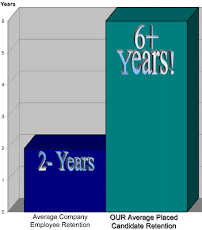











 Posts
Posts


