Sunday


Monday
Want to put Americans back to work? Insourcing for Job Growth
Insourcing - The Secret to Job Growth in America.
By ROBERT M. KIMMITT AND MATTHEW J. SLAUGHTER
The Labor Department reported on Friday that the U.S. unemployment rate is now 9.8%, as the economy added only 39,000 jobs in November. Since the start of the Great Recession, America has lost nearly 7.3 million private-sector jobs. Today's 108 million private-sector jobs are the same number America had in April 1999. And unemployment, Federal Reserve officials predicted last week, will likely remain at 9% through 2011.
Meanwhile, U.S. policy makers are fiercely divided over how to support job growth. The Fed's second round of quantitative easing triggered sharp criticism both at home and abroad, and fiscal prospects remain bleak, with little prospect for additional stimulus. So what is to be done if neither monetary nor fiscal policy will spur job creation?
Last month a Survey of Current Business report by the U.S. Bureau of Economic Analysis suggested—perhaps accidentally—a promising new approach. The report documented a dynamic group of companies that create high-paying American jobs based on significant capital investment and export prowess—precisely the kinds of jobs America desperately needs to build a sustainable recovery.
In 2008, these companies employed 5.6 million Americans, 4.7% of total private-sector employment. In the U.S. private sector that year, these companies accounted for 11.3% of capital investment ($187.5 billion), 14.3% of research and development ($40.5 billion), and 18.1% of goods exports ($232.4 billion). All these activities contribute to good-paying jobs. In 2008, total U.S. compensation at these companies was $408.5 billion—a per-worker average of $73,023. That's about one-third more than the average for all other U.S. workers.
So which companies are these? Ones that "insource"—that is, the U.S. operations of multinational firms based abroad. Insourcing companies now employ more than twice the number of Americans they employed in 1987. According to a recent survey by the Organization for International Investment, the chief financial officers of insourcing companies continue to see growth opportunities in America. Almost 50% plan to increase U.S. employment over the next 12 to 18 months, and just 22% plan to reduce it.
To boost the hiring prospects of insourcing companies (and of many others as well), policy makers should focus on three issues quite distinct from macroeconomic tools like quantitative easing and federal stimulus spending.
First, taxes. Insourcing CFOs reported to the Organization for International Investment that taxation is the single most important policy area that shapes their companies' investment decisions. In turn, their top concern is the U.S. corporate tax rate, which, at 35%, is one of the world's highest.
America's high corporate tax rate inhibits hiring and investment in all U.S. firms, big and small alike. All the recent proposals by prominent deficit-reduction panels have recommended cutting the statutory rate and simplifying the corporate tax code. Policy makers should act on these proposals as quickly as possible to reduce the uncertainty that is inhibiting businesses' hiring and investment.
Second, trade. The global production and distribution networks of insourcing companies foster lots of exports and related jobs. So does trade liberalization. The more U.S. policy makers enact free-trade agreements with other nations, the more insourcing companies will be able to expand their exports and related jobs. Insourcing companies owned by South Korean parents exported $10.5 billion in goods in 2008; this would likely grow if America could ratify the pending free trade agreement with South Korea.
Third, tone. A worrisome 72.2% of insourcing CFOs say that the environment for doing business in America deteriorated over the last year. Contributing to this deterioration were the "Buy American" provisions of the 2009 American Recovery and Reinvestment Act. This protectionist tone belies the reality that America today is in a new era of global competition to attract the dynamic operations of global companies.
Last week's news (from the OECD) that global cross-border investment flows fell again in 2010 only intensifies this competition. To meet it, America should set a more welcoming and optimistic tone. A good start would be an "open investment policy" statement from President Obama affirming America's commitment to promoting international investment.
Mr. Kimmitt, who served as deputy secretary of the Treasury from 2005-2009, is independent chairman of the Deloitte Center for Cross-Border Investment. Mr. Slaughter, who was a member of the council of economic advisers from 2005 to 2007, is an adviser to the Deloitte Center.
By ROBERT M. KIMMITT AND MATTHEW J. SLAUGHTER
The Labor Department reported on Friday that the U.S. unemployment rate is now 9.8%, as the economy added only 39,000 jobs in November. Since the start of the Great Recession, America has lost nearly 7.3 million private-sector jobs. Today's 108 million private-sector jobs are the same number America had in April 1999. And unemployment, Federal Reserve officials predicted last week, will likely remain at 9% through 2011.
Meanwhile, U.S. policy makers are fiercely divided over how to support job growth. The Fed's second round of quantitative easing triggered sharp criticism both at home and abroad, and fiscal prospects remain bleak, with little prospect for additional stimulus. So what is to be done if neither monetary nor fiscal policy will spur job creation?
Last month a Survey of Current Business report by the U.S. Bureau of Economic Analysis suggested—perhaps accidentally—a promising new approach. The report documented a dynamic group of companies that create high-paying American jobs based on significant capital investment and export prowess—precisely the kinds of jobs America desperately needs to build a sustainable recovery.
In 2008, these companies employed 5.6 million Americans, 4.7% of total private-sector employment. In the U.S. private sector that year, these companies accounted for 11.3% of capital investment ($187.5 billion), 14.3% of research and development ($40.5 billion), and 18.1% of goods exports ($232.4 billion). All these activities contribute to good-paying jobs. In 2008, total U.S. compensation at these companies was $408.5 billion—a per-worker average of $73,023. That's about one-third more than the average for all other U.S. workers.
So which companies are these? Ones that "insource"—that is, the U.S. operations of multinational firms based abroad. Insourcing companies now employ more than twice the number of Americans they employed in 1987. According to a recent survey by the Organization for International Investment, the chief financial officers of insourcing companies continue to see growth opportunities in America. Almost 50% plan to increase U.S. employment over the next 12 to 18 months, and just 22% plan to reduce it.
To boost the hiring prospects of insourcing companies (and of many others as well), policy makers should focus on three issues quite distinct from macroeconomic tools like quantitative easing and federal stimulus spending.
First, taxes. Insourcing CFOs reported to the Organization for International Investment that taxation is the single most important policy area that shapes their companies' investment decisions. In turn, their top concern is the U.S. corporate tax rate, which, at 35%, is one of the world's highest.
America's high corporate tax rate inhibits hiring and investment in all U.S. firms, big and small alike. All the recent proposals by prominent deficit-reduction panels have recommended cutting the statutory rate and simplifying the corporate tax code. Policy makers should act on these proposals as quickly as possible to reduce the uncertainty that is inhibiting businesses' hiring and investment.
Second, trade. The global production and distribution networks of insourcing companies foster lots of exports and related jobs. So does trade liberalization. The more U.S. policy makers enact free-trade agreements with other nations, the more insourcing companies will be able to expand their exports and related jobs. Insourcing companies owned by South Korean parents exported $10.5 billion in goods in 2008; this would likely grow if America could ratify the pending free trade agreement with South Korea.
Third, tone. A worrisome 72.2% of insourcing CFOs say that the environment for doing business in America deteriorated over the last year. Contributing to this deterioration were the "Buy American" provisions of the 2009 American Recovery and Reinvestment Act. This protectionist tone belies the reality that America today is in a new era of global competition to attract the dynamic operations of global companies.
Last week's news (from the OECD) that global cross-border investment flows fell again in 2010 only intensifies this competition. To meet it, America should set a more welcoming and optimistic tone. A good start would be an "open investment policy" statement from President Obama affirming America's commitment to promoting international investment.
Mr. Kimmitt, who served as deputy secretary of the Treasury from 2005-2009, is independent chairman of the Deloitte Center for Cross-Border Investment. Mr. Slaughter, who was a member of the council of economic advisers from 2005 to 2007, is an adviser to the Deloitte Center.
Be a better manager

About the biggest mistake successful managers make is thinking they’ve got all the answers. Let’s face it, when you’ve got enough successes and failures under your belt and plenty of gray hair on your head, it’s a natural tendency to spend more of your time talking than listening.
That’s a pitfall none of us should fall into, and that includes me. While it sometimes seems like I have enormous disdain for some “leadership gurus,” especially the academic type, I’m always on the lookout for folks who, like me, have real-world management experience and the inclination to share it with others.
Saturday
Call for Papers: 2011 IEEE International Technology Management Conference
ITMC 2011 Call for Papers
Call for Papers
2011 IEEE International Technology
Management Conference
ITMC2011
Hilton San Jose
San Jose, California USA
June 27-30 2011
Managing Technology in Challenging Times
We invite contributions from researchers, educators, managers and students. Contributions may be
conceptual, theoretical, or empirical. They should document research activity, case studies or best
practices, shedding light on the theory or practice of engineering, technology, or innovation management,
and address the strategic objective of technological change. Major topic areas include:
Globalization and its Implications
- Outsourcing and Off-shoring
- Globalization of Research & Development
- Role of Silicon Valley and Other Technology Centers in the World
- Adapting Business Practices to the New Era
Entrepreneurship
- Opportunity Recognition in a challenging environment
- Innovative Business models
- International Sources of Capital
- Legal Aspects of International Entrepreneurship
Management of Innovation
- R&D during the Economic Downturn
- New Measures of Innovation
- Management of Innovation Processes
- Alternative Energy opportunities and pitfalls
- Open Innovation and Collaboration in Technology Management
Adapting to Change for Employees
- Career Planning
- Employee’s View of Management
- Organizational Learning from Past Management
- Education in Technology Management
- Employee Innovation in the Wake of Recession
Supply Chain Management
- Sourcing Management
- Logistics and Distribution
- Product Development and Production Management
- Strategic Issues in Supply Chains
- Sustainable Supply Chains
Sustainability
- Green Product and Process Development
- Engineering Management and Climate Change
- Safety and Health Management
- Ecological Modernization
- Project Management for Sustainable Solutions
- Green Information Technology
In addition to these core technology management topics, we will open the door to special sessions on management during these
challenging times as seen by sponsoring societies – for example, particular management issues as seen within computer,
communications, and electronics areas.
Important Dates: Paper Submission Due: 1 December 2010
Notification of Acceptance: 1 March 2011 Paper & Author Registration Due: 15 April 2011
Hotel Block Deadline: 27 May 2011 Late Registration Begins: 15 June 2011
Organizing Committee:
General Co-chairs: Michael Condry (Intel), Atif Shaikh (Altera)
Technical Co-chairs: Xiaohong “Iris” Quan (San Jose State), George Farris (Rutgers)
Treasurer: Richard Stallkamp (Electronic Medical Devices)
Secretary: Ken Knox (Maxim Integrated Products)
For additional information, visit the conference Web page at www.ieee-itmc.org
Call for Papers
2011 IEEE International Technology
Management Conference
ITMC2011
Hilton San Jose
San Jose, California USA
June 27-30 2011
Managing Technology in Challenging Times
We invite contributions from researchers, educators, managers and students. Contributions may be
conceptual, theoretical, or empirical. They should document research activity, case studies or best
practices, shedding light on the theory or practice of engineering, technology, or innovation management,
and address the strategic objective of technological change. Major topic areas include:
Globalization and its Implications
- Outsourcing and Off-shoring
- Globalization of Research & Development
- Role of Silicon Valley and Other Technology Centers in the World
- Adapting Business Practices to the New Era
Entrepreneurship
- Opportunity Recognition in a challenging environment
- Innovative Business models
- International Sources of Capital
- Legal Aspects of International Entrepreneurship
Management of Innovation
- R&D during the Economic Downturn
- New Measures of Innovation
- Management of Innovation Processes
- Alternative Energy opportunities and pitfalls
- Open Innovation and Collaboration in Technology Management
Adapting to Change for Employees
- Career Planning
- Employee’s View of Management
- Organizational Learning from Past Management
- Education in Technology Management
- Employee Innovation in the Wake of Recession
Supply Chain Management
- Sourcing Management
- Logistics and Distribution
- Product Development and Production Management
- Strategic Issues in Supply Chains
- Sustainable Supply Chains
Sustainability
- Green Product and Process Development
- Engineering Management and Climate Change
- Safety and Health Management
- Ecological Modernization
- Project Management for Sustainable Solutions
- Green Information Technology
In addition to these core technology management topics, we will open the door to special sessions on management during these
challenging times as seen by sponsoring societies – for example, particular management issues as seen within computer,
communications, and electronics areas.
Important Dates: Paper Submission Due: 1 December 2010
Notification of Acceptance: 1 March 2011 Paper & Author Registration Due: 15 April 2011
Hotel Block Deadline: 27 May 2011 Late Registration Begins: 15 June 2011
Organizing Committee:
General Co-chairs: Michael Condry (Intel), Atif Shaikh (Altera)
Technical Co-chairs: Xiaohong “Iris” Quan (San Jose State), George Farris (Rutgers)
Treasurer: Richard Stallkamp (Electronic Medical Devices)
Secretary: Ken Knox (Maxim Integrated Products)
For additional information, visit the conference Web page at www.ieee-itmc.org
Sunday
If no one had a sociopath for a boss, who would start new businesses?
Bad Management
If no one had a sociopath for a boss, who would start new businesses?
"Imagine a parallel universe where employees enjoy going to work. They feel empowered and fulfilled—so much so that they don't care about the size of their paychecks and never want to leave their jobs. That's exactly the sort of nightmare scenario that would destroy the economy. The last thing this world needs is a bunch of dopey-happy workers who can't stop humming and grinning. Our system requires a continuous supply of highly capable people who are so disgruntled with their jobs that they are willing to chew off their own arms to escape their bosses. The economy needs hamster-brained sociopaths in management to drive down the opportunity cost of entrepreneurship. Luckily, we're blessed with an ample supply." said SCOTT ADAMS, the creator of Dilbert in a recent article in the Wall Street Journal.
As a headhunter, there is more truth than humor in Mr. Adams article. Bad managers are the reason many people answer the phone when I call. Most of these people are managers themselves, abused by higher management - from outright narcisism and sociopathic executives to just a lack of opportunity to grow in a company.
"Though most of my immediate bosses were entirely reasonable and competent, the organization at large was riddled with hamster-brained sociopaths in leadership roles. Surely, I thought, this must be a problem that exists no place else on Earth. Otherwise we'd all be living in caves and holding long meetings on the feasibility of using sticks as stabby things.
The economy needs workers who are fed up, desperate and willing to quit their jobs for something better. Remember, only quitters can be winners, because you can't do something great until first you quit doing something that isn't.
I have always assumed there's a correlation between imagination and risk-taking. You wouldn't leave an unpleasant but relatively safe situation unless you could imagine a better outcome. So the people who leave a company first tend to be the visionaries who can best imagine entrepreneurial success. Bad management is how imagination gets wings." To read Scott Adams funny yet thought provoking article:
http://online.wsj.com/article/SB10001424052748704353504575596372042140924.html?KEYWORDS=the+perfect+stimulus:+bad+management
If no one had a sociopath for a boss, who would start new businesses?
"Imagine a parallel universe where employees enjoy going to work. They feel empowered and fulfilled—so much so that they don't care about the size of their paychecks and never want to leave their jobs. That's exactly the sort of nightmare scenario that would destroy the economy. The last thing this world needs is a bunch of dopey-happy workers who can't stop humming and grinning. Our system requires a continuous supply of highly capable people who are so disgruntled with their jobs that they are willing to chew off their own arms to escape their bosses. The economy needs hamster-brained sociopaths in management to drive down the opportunity cost of entrepreneurship. Luckily, we're blessed with an ample supply." said SCOTT ADAMS, the creator of Dilbert in a recent article in the Wall Street Journal.
As a headhunter, there is more truth than humor in Mr. Adams article. Bad managers are the reason many people answer the phone when I call. Most of these people are managers themselves, abused by higher management - from outright narcisism and sociopathic executives to just a lack of opportunity to grow in a company.
"Though most of my immediate bosses were entirely reasonable and competent, the organization at large was riddled with hamster-brained sociopaths in leadership roles. Surely, I thought, this must be a problem that exists no place else on Earth. Otherwise we'd all be living in caves and holding long meetings on the feasibility of using sticks as stabby things.
The economy needs workers who are fed up, desperate and willing to quit their jobs for something better. Remember, only quitters can be winners, because you can't do something great until first you quit doing something that isn't.
I have always assumed there's a correlation between imagination and risk-taking. You wouldn't leave an unpleasant but relatively safe situation unless you could imagine a better outcome. So the people who leave a company first tend to be the visionaries who can best imagine entrepreneurial success. Bad management is how imagination gets wings." To read Scott Adams funny yet thought provoking article:
http://online.wsj.com/article/SB10001424052748704353504575596372042140924.html?KEYWORDS=the+perfect+stimulus:+bad+management
Monday
Bosses Overestimate Their Managing Skills
Bosses who think they're the next Jack Welch might want to reassess their talent level.
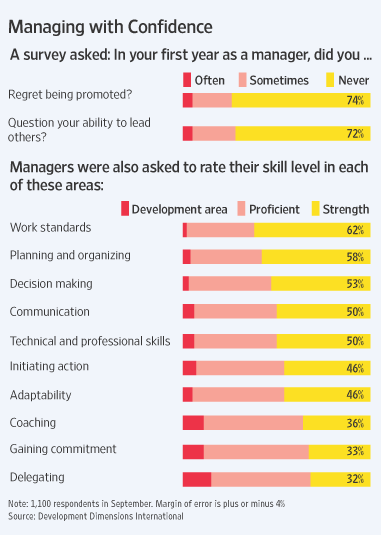
A new survey of 1,100 front-line managers suggests many are over-estimating their skills, with surprisingly little self-doubt. Seventy-two percent said they never questioned their ability to lead others in their first year as a manager.
Managers were also unlikely to rate themselves as weak in a number of leadership attributes, such as planning, communication and adaptability, according to the study by consulting firm Development Dimensions International Inc.
Front-line managers believe that their biggest strengths are in setting work standards and planning and organizing, according to the survey.
The skills they said they most needed to work on were delegating, coaching and gaining commitment—but no more than 15% of managers pointed to any one of those as a "development area."
"It doesn't matter what industry you're in. People have blind spots about where they're weak," says Scott Erker, a senior vice president at DDI, which conducted the survey in September.
The company separately compared some managers' self-assessments to performance in a business simulation that attempted to mimic real-world challenges the leaders might face. They found that managers consistently over-rated their delegating and coaching abilities, Mr. Erker says.
On the other hand, the company didn't find any consistent pattern of "hidden strengths," or areas in which managers underestimated their skills, he says.
One problem: When workers become managers, they're often surrounded by employees who flatter them as a way of ingratiating themselves to their boss, said Stanford business professor Jeffrey Pfeffer, author of the book "Power."
"People also don't understand the feedback they get. They either mishear or choose not to hear criticism," he said.
Still, at least some front-line managers harbor some doubts. About 26% of front-line managers said that they regretted being promoted at least sometimes during their first year, according to the DDI study. Fifteen percent said that their interest in being a manager decreased since being promoted. - By JOE LIGHT on the Wall Street Journal
Friday
EV market Predicted to Grow 7%-30% depending on which study you believe.

The WSJ this week published an article looking at the "overhype" of EV's....."A well known auto-industry forecasting firm on Wednesday suggested that the heavily promoted battery-powered vehicles about to appear on roads around the world are "overhyped" and headed for a much slower takeoff than some auto makers and industry analysts expect.
In the new study, J.D. Power & Associates said sales of electric cars are likely to remain low for the next several years and won't make up more than a small slice of the global market even 10 years down the road.
The combined sales total of hybrid cars such as the Toyota Motor Corp. Prius and all-electric models like the Nissan Motor Co. Leaf will come to just 5.2 million in 2020, J.D. Power said. That would represent just 7.3% of the global market in 2020, which J.D. Power sees reaching 70.9 million passenger vehicles then.
Some auto makers and other forecasters are more bullish. General Motors Co. and Nissan are spending billions of dollars to market electric cars they hope will become mainstream vehicles. The Chevrolet Volt, made by GM, and the Nissan Leaf are due to arrive in showrooms in the U.S. in the next few months. A separate study by Boston Consulting Group sees hybrids and electric vehicles making up 26% of the global passenger car market in 2020. PRTM, another research firm, estimates the total may be closer to 30% as battery prices fall and the price of the vehicles comes closer to standard models.
Many countries around the world, including the U.S. and Israel, are supporting the introduction of electric vehicles with tax breaks and other financial incentives as part of an effort to reduce petroleum consumption and cut greenhouse gas emissions.
"Everybody feels that everybody else should be driving environmentally friendly vehicles. Although consumers generally want to be environmentally conscious, they are much more conscious of their personal economics," said Dave Sargent, J.D. Power's vice president of automotive research. "Right now, consumers have a lot of unanswered questions about the purchase premium of a hybrid or all-electric vehicle."
J.D. Power said that without a dramatic rise in fuel prices, a coordinated global governmental push or a technological breakthrough that lowers the cost of the cars, consumers are unlikely to adopt the vehicles. The researcher didn't find that any of these were very likely to happen.
J.D. Power pointed to consumer surveys to underpin its findings. Buyers didn't like the physical appearance and perceived performance of hybrids and worried about the limited range and recharging times for all-electric models.
"Based on our research of consumer attitudes toward these technologies—and barring significant changes to public policy, including tax incentives and higher fuel-economy standards—we don't anticipate a mass migration to green vehicles in the coming decade," said John Humphrey, J.D.'s senior vice president of automotive operations.
More than 20 electric vehicles are planned to go on sale in the U.S. in the next three years and the U.S. government has backed $5 billion in investments for battery technology and consumer incentives to kick-start the market.
The alliance of Nissan and Renault SA has invested $4 billion in a suite of electric vehicles due out over the next several years and anticipates 10% of global industry sales in 2020 will be all-electric models. That would equate to about seven million vehicles based on J.D. Power's industry forecast for sales in 2020.
J.D. Power estimates that the U.S. market in 2020 will account for purchases of about 100,000 pure-electric cars in total, or about two-thirds of the annual U.S. sales of Toyota Prius hybrids last year. Hybrids will make up 1.7 million in sales that year under the forecast.
Europe will be the largest market for electric cars, making up more than half the projected 1.3 million sales, J.D. Power says.
Seifi Ghasemi, the chairman and chief executive officer of Rockwood Holdings, which produces the lithium chemicals needed for advanced batteries as well as other chemicals, said in an interview Tuesday that some people underestimate the potential attraction of electric vehicles.
"I think we might be underestimating the enthusiasm of the customers," Mr. Ghasemi said. He said governments could and should be doing more to press for the adoption of electric vehicles as a national security and economic concern.
"Unless we change the internal combustion engine to something other than that—it doesn't solve the fundamental issue of energy security," he said."
- Mike Ramsey at michael.ramsey@wsj.com
Wednesday
Monday
What Good Bosses Do

bosses aren’t usually aware that they are bad bosses. The fact is that nobody wants to believe they’re the problem. Nevertheless, there’s a bell curve for all things involving people, which means there are few really bad bosses, few really good bosses, and most of you fall somewhere in the middle.
To me that says, for the vast majority of you, there’s lots of room for improvement.
So, if you’re not exhibiting any of the 7 Signs, that’s great, pat yourself on the back. Still, if you really want to up your management game, maybe even vault into the executive or ownership ranks someday, you’d better start doing at least a few of these 10 Things That Good Bosses Do.
Incidentally, this isn’t from some academic study. These are real attributes of real bosses, culled from decades of observation, which motivate and inspire employees to perform at their best.
1. Pay people what they’re worth, not what you can get away with. What you lose in expense you gain back several-fold in performance.
2. Take the time to share your experiences and insights. Labels like mentor and coach are overused. Let’s be specific here. Employees learn from those generous enough to share their experiences and insights. They don’t need a best friend or a shoulder to cry on.
3. Tell it to employees straight, even when it’s bad news. To me, the single most important thing any boss can do is to man up and tell it to people straight. No BS, no sugarcoating, especially when it’s bad news or corrective feedback.
4. Manage up … effectively. Good bosses keep management off employee’s backs. Most people don’t get this, but the most important aspect of that is giving management what they need to do their jobs. That’s what keeps management away.
5. Take the heat and share the praise. It takes courage to take the heat and humility to share the praise. That comes naturally to great bosses; the rest of us have to pick it up as we go.
6. Delegate responsibility, not tasks. Every boss delegates, but the crappy ones think that means dumping tasks they hate on workers, i.e. s**t rolls downhill. Good bosses delegate responsibility and hold people accountable. That’s fulfilling and fosters professional growth.
7. Encourage employees to hone their natural abilities and challenge them to overcome their issues. That’s called getting people to perform at their best.
8. Build team spirit. As we learned before, great groups outperform great individuals. And great leaders build great teams.
9. Treat employees the way they deserve to be treated. You always hear people say they deserve respect and to be treated as equals. Well, some may not want to hear this, but a) respect must be earned, and b) most workers are not their boss’s equals.
10. Inspire your people. All the above motivate people, but few bosses have the ability to truly inspire their employees. How? By sharing their passion for the business. By knowing just what to say and do at just the right time to take the edge off or turn a tough situation around. Genuine anecdotes help a lot. So does a good sense of humor.
All this adds up to an environment where people feel appreciated, recognized, challenged, and appropriately compensated.
By Steve Tobak
http://www.bnet.com/blog/ceo/10-things-that-good-bosses-do/5868?promo=665&tag=nl.e665
Subscribe to:
Posts (Atom)















 Posts
Posts


